








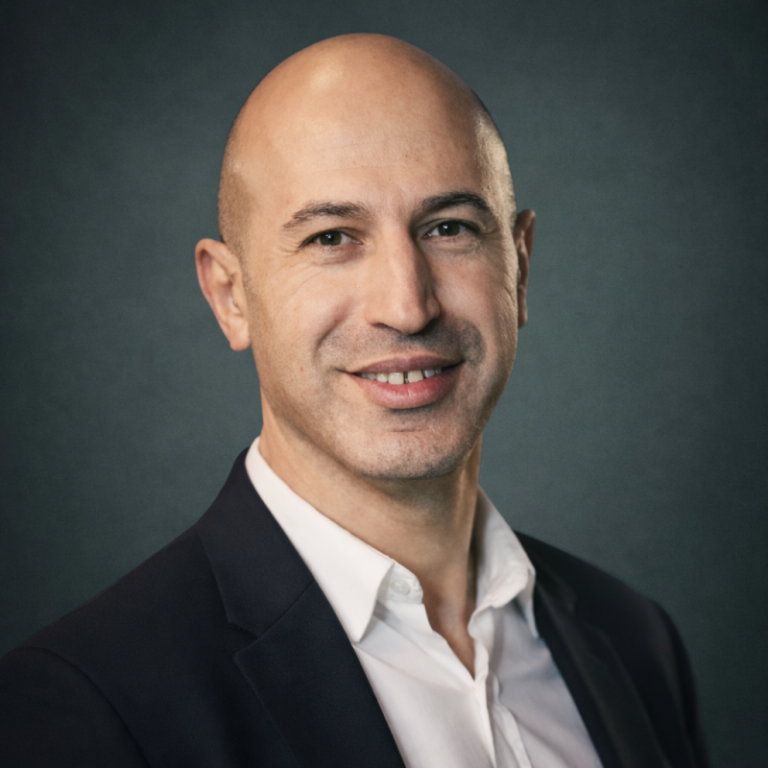
“Every time I left a stable setting, I came out stronger,” says Noureddine Tabete when asked to name three moments that shaped the person he has become. In 1995, aged 19, he left Morocco to study architecture in Brussels before joining the École Polytechnique Fédérale de Lausanne (EPFL) in Switzerland to study communication systems. An experience that taught him to think differently, in languages, cultures and systems other than his own. In 2006, he returned to Morocco with a fresh view of his country and of himself. Then, in 2017, after several years at companies including Microsoft and Hewlett-Packard, he chose to leave salaried employment and become an entrepreneur, founding Atlantis Digit, which became Nalida Power.
Swiss rigour at a Moroccan pace
From his years in Switzerland, Noureddine Tabete has kept three reflexes that still guide the way he works: rigour, transparency and peace of mind. “Rigour – to understand, assess, document and deliver on time, whatever the stakes. Transparency – to tell things as they are, to teams as well as to clients and partners, even when the message is uncomfortable. And peace of mind – to stay calm in the face of complexity and, above all, adversity,” he explains.
An approach he sums up in a few words: “This Swiss triptych, applied to Moroccan tempo and creativity, is probably my greatest added value when it comes to steering sensitive matters or large-scale projects.”
A philosophy also shaped by encounters. Among those that marked his path was Madame Bruttin, head of the IT department at La Placette in Morges, now Manor, who gave him his first real student job in 1998. “She taught me that you can be uncompromising on what matters and tolerant of anything that does not stray from your values. She also taught me that high standards and kindness are not mutually exclusive – they reinforce each other,” he recalls.
The duty to pass it on
This idea of passing things on now finds a natural extension in Noureddine Tabete’s commitment as head of EPFL Alumni Morocco because, for him, benefiting from an outstanding education comes with a responsibility towards the generations that follow: “An outstanding degree is not an annuity, it is a debt.”
In his view, being an alumnus means making accessible to others what you yourself received. A conviction that translates into “giving back” through conferences, masterclasses, one-to-one mentoring and introductions to recruiters and investors.
“We are custodians of what we have received – an education, a network, opportunities – and this capital can only grow through sharing. Passing it on is not giving back exactly what you received; it is making it grow by letting it circulate,” stresses Noureddine, who pays particular attention to young people who do not start out with the codes or the network needed to find their place. And for him, “a mentor first brings concrete experience and, almost more importantly, hope, […] which helps the young person build their own confidence.”
An approach in line with his view of mentoring as “one of the rare investments where both parties systematically win.”
“The challenge now is to structure these bridges so that they become pools of concrete projects, not just good intentions.”
Building bridges for young talent
When he talks about young Moroccan talent, Noureddine Tabete believes they lack neither potential nor ambition. “What young people often lack is a safety net that lets them take risks, make mistakes and pay the price, but bounce back without giving up,” he explains. Networks and mentoring can, in his view, help reduce the cost of failure and allow young people to turn more of their boldness into projects.
A mission in which alumni networks have a particular role to play. Like EPFL Alumni Morocco, which he believes can turn the connections between Switzerland and Morocco, academia and business, or technology and entrepreneurship into concrete opportunities. “The challenge now is to structure these bridges further so that they become pools of concrete projects, not just good intentions,” he says.
When the engineer meets the artist
Engineer and entrepreneur, Noureddine Tabete is also an artist. A passion that has always coexisted with his scientific and entrepreneurial path, but which took on a new dimension during the Covid period, when he presented his first exhibition.
For him, there is no contradiction between these different sides. “I see no break between the engineer, the entrepreneur and the artist in me – all three share the same drive to turn an intuition into something concrete that can be shown, whether a canvas, a solar street lamp or a digital transformation that moves a country or a sector forward,” he argues.
“In a world increasingly focused on ‘saying’, ‘doing’ remains the rarest and most decisive skill.”
Asked how he balances his professional activities, his work for the association and his art, Noureddine Tabete replies: “There is a time for everything, and the key is knowing the moment, the method and the place to recharge. For me, that means triathlon, which demands a physical and mental discipline quite close to running a start-up: you move forward step by step, manage your effort over time and learn to take the bad days without giving up the race. Art, on the other hand, gives me the opposite space, where it is hard to time and budget everything in advance.”
As for his legacy to future generations, Noureddine Tabete wants to pass on the ability to do rather than to say: “In a world increasingly focused on ‘saying’ – social media, artificial intelligence, an abundance of knowledge one click away – ‘doing’, in the sense of getting things done, remains the rarest and most decisive skill, while what makes a lasting difference is the ability to turn words or ideas into tangible results, consistently.” A philosophy that alone sums up Noureddine Tabete’s path, marked by movement, ideas made real and passing things on.
The “if you were” game:
If you were…
– A colour, which one and why?
Red, because it is pure and active
– A city?
Rabat and Lausanne, because they have everything at once
– A work of art or an artist?
Santiago Calatrava, the Spanish architect-engineer, because his work proves that function, structure and beauty are not contradictory – exactly the conviction that drives Nalida Power.
– A personality…?
Leonardo da Vinci, for convergence and refusing boundaries between disciplines.
– An animal…?
A feline, endearing and sensitive enough but very independent
– A connected object?
BreathRee, Nalida Power’s connected solar tree
– A superpower?
Pleasing everyone
– A song…?
Redemption Song by Bob Marley, because it brings together Africa, freedom, responsibility, conscience and inner resistance.