






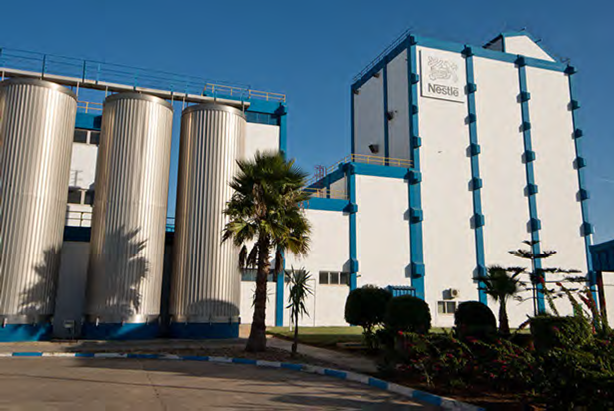
If there are two commitments Nestlé has never failed to honour in its 150 years of existence, they are quality and food safety. Thanks to its global Research & Development network, the Group provides its consumers with innovative products offering nutrition, health and wellness benefits that are proven and backed by clinical tests. This professional rigour and all these efforts have helped to position the Group as a benchmark in nutrition, health & wellness, sustainable financial performance and social & civic commitment. That said, its status as a giant has not prevented Nestlé from adapting to local realities. Quite the contrary! If the Group has built factories in Morocco, Algeria and Tunisia, it is to be closer to consumers in the Maghreb region and better meet their needs.
Active brands suited to local tastes
Because tastes differ from one generation, one country and sometimes even one gender to another, the Group has put in place specific arrangements to adapt its products to local tastes, as is the case in the Maghreb. NESCAFÉ® 3in1 CREM, which combines coffee, milk and sugar, is the most recent example. Aimed mainly at young people and very popular with them, this product was launched in Morocco, after Algeria, with a large-scale marketing campaign. As the history of Nestlé Maghreb is linked to each of the Group’s brands, Nestlé has been able to meet the needs of its Maghreb consumers with a wide range of products: dairy (NIDO, NESPRAY and Sweetened Condensed Milk), culinary (MAGGI®, soups and seasonings), infant nutrition (NAN, GUIGOZ and NATIVA), soluble coffee (NESCAFÉ®), infant cereals (CERELAC), cereals (NESQUIK, CRUNCH, CHOCAPIC and GRAIN D’OR), chocolate powder (NESQUIK) and, finally, Nestlé Professional (NESCAFÉ® and NESTEA).
Creating Shared Value at the heart of Nestlé’s strategy
The multinational is also a model in view of its social and sustainable initiatives. A pioneer in the field, it took an interest in sustainable development long before the term entered everyday language. Indeed, Nestlé has placed Création de Valeur Partagée, or Creating Shared Value (CSV), at the heart of the Group’s strategy for integrating into its environment. It has thus contributed to the social and economic development of Morocco, through an initial investment of 500 million dirhams and the implementation of a number of continuous improvement programmes. Thanks to the co-development partnership with the Group, thousands of Moroccan farmers and their families are able to support themselves through employment. A win-win strategy that is part of a logic of investments that benefit Nestlé as much as the communities in the regions where the Group operates. Nestlé Maroc also promotes education by funding schools that welcome several thousand children a year, and supports women’s dairy cooperatives, particularly in the city of Safi in Morocco, to encourage women to work and be independent. And that is not all! Water conservation is also a challenge for Creating Shared Value within the Group. A challenge already met by Nestlé Maghreb at the El Jadida plant, where the factory has long had its own treatment plant for wastewater.
Three questions for:
Bruno Le Ciclé, Chairman and CEO of Nestlé Maghreb
How is Nestlé doing in Morocco?
Nestlé Maroc is doing well. The trend is good, and both our social and economic activities are progressing thanks to the synergy and expertise of our teams.
What do you think of the economic relations between Switzerland and Morocco?
They are solid and stable economic relations. The two countries recently celebrated 60 years of diplomatic relations. Switzerland is the fifth-largest foreign investor in Morocco, thanks to the 600 million euros committed by its companies in the Kingdom.
A word about the CCSM?
We warmly welcome the initiatives of the CCSM, which has just celebrated its 30th anniversary. A highly significant period that once again reflects the stability of relations between the two countries. We take part in the various meetings organised by the CCSM. As a Swiss company, we find these meetings very informative, and they enable us to make connections that can lead to business opportunities.
Nestlé in figures:
- 2000 brands
- 328,000 employees
- 40 research centres
- 5,000 employees in research &development
- 418 factories in 86 countries
- 89.5 billion (CHF) in turnover in 2016