






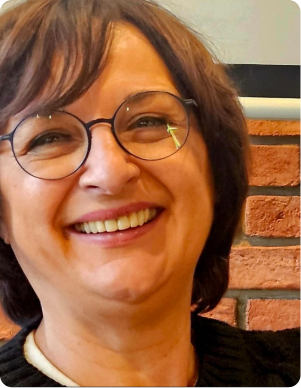
Some vocations are born of a choice. Others take root in an ordeal. For Dr Myriam Belghazi Nciri, it all began in the year of her baccalaureate. As she was considering entering a preparatory class, her father died of cancer. “I then went through what so many families go through: helplessness in the face of the disease and that human suffering which sometimes seems to remain unanswered. That is probably where my vocation was born.”, she says. She eventually chose to study medicine in Bordeaux, in the hope of better understanding and better supporting patients. There she discovered a medicine marked by scientific rigour, but also the limits of an approach sometimes centred on the disease when, as she points out, “it is a whole person who is suffering”.
When the patient joins the doctor
After several years in the pharmaceutical industry, life in turn placed her on the other side of care. In 2006, she was diagnosed with cancer. A personal ordeal that acted as a revelation and rekindled long-standing questions about the meaning of care and the resources that make it possible to get through illness. “This ordeal rekindled the questions that had been with me for a long time about the meaning of care, quality of life and the resources that make it possible to get through illness.”, she adds.
Then began a real journey of exploration. She discovered the work of David Servan-Schreiber, Thierry Janssen and many authors interested in resilience, quality of life and support for people who are ill. This quest also led her towards coaching and then towards medical hypnosis, which she chose to study in Paris.
Convinced of the value of these complementary approaches, in 2010 she founded the Moroccan Association of Clinical Hypnosis (AMHYC), with the ambition of helping to spread them among Moroccan healthcare professionals. “Caring is not just about treating a disease. Quality of life, listening and human support are an integral part of care.”
Dar Zhor, born of a conviction
Over the course of this exploration, one thing became obvious. While medicine heals, support makes it possible to preserve quality of life, break isolation and give patients back the resources they need to get through the ordeal. A conviction that would find concrete expression a few years later.
This conviction took shape in 2016 with the creation of Dar Zhor.
In the course of her research, Dr Myriam Belghazi Nciri visited several pioneering facilities in France. There she discovered a deeply human approach, complementary to medical treatment and based on solid scientific evidence. She then realised that no such service yet existed in Morocco.
With two friends who had also been through cancer, she founded Dar Zhor with a simple ambition: “To offer people affected by cancer a place where the person is cared for as much as the disease.”
Today, Dar Zhor has become the first Moroccan centre dedicated to supportive care in oncology. Its model is based on a holistic approach combining psychological support, adapted physical activity, nutrition, hypnosis, support groups, art therapy and support for family caregivers.
When business becomes a partner in care
Dar Zhor was built step by step, driven by a small permanent team and nearly forty volunteer professionals united around a shared vision: supporting the person as a whole.
To turn this ambition into reality, it was also necessary to convince partners willing to support a model still unprecedented in Morocco. “The first partners who placed their trust in us were several international pharmaceutical laboratories committed to the fight against cancer, notably Swiss groups such as Roche and Novartis.” Their support made it possible to fund the first awareness-raising and support activities, helping an innovative approach to cancer care to emerge.
Nearly ten years after its creation, Dar Zhor has demonstrated the relevance of its model. The challenge now is to scale up by gradually developing other centres in the Kingdom’s main cities.
But this ambition also comes up against the reality of funding. “Every year, we have to devote considerable energy to seeking the resources we need to operate.” For the founder of Dar Zhor, the challenge is rather to keep supporting this approach and to give it the means to grow. This means strengthening partnerships with companies and institutions that share this vision of healthcare more centred on the person and on quality of life.
Results that give meaning
In 2025, Dar Zhor supported 450 beneficiaries through 623 workshops and consultations run by nearly forty volunteer professionals, notably for the 2024 campaign. But one of the project’s major advances lies in the scientific demonstration of its impact. A rigorous psychosocial study revealed a significant improvement in beneficiaries’ quality of life, including in particular a reduction in stress, anxiety, fatigue, feelings of isolation and pain.
Presented in 2025 at the MASCC and ASCO international congresses in the United States, these results represent the first scientific evaluation of a supportive care pathway carried out in Morocco.
For Dr Myriam Belghazi Nciri, this recognition confirms her conviction: when structured, human support complements medical treatment, it tangibly improves patients’ experience.
Making the forgotten ones of cancer visible
Among the causes she champions today is that of family caregivers. “Cancer never affects just one person. When a diagnosis is made, a whole family balance is shaken.” For her, supporting loved ones is not a secondary issue. They often become the invisible coordinators of the care pathway, sometimes at the cost of their own physical and psychological well-being.
The same observation now guides the actions carried out around the theme “Cancer and Work”, in order to raise companies’ awareness of the realities experienced by patients and to foster better professional inclusion of people affected by the disease. Her ambition is to break down prejudices so that those concerned can fully keep their place in society and in the world of work.
And when asked where she finds her balance, she tells us: “I find it in simple moments: my family, reading, writing and human encounters.” A philosophy of life nourished by a conviction that has been with her for a long time: “Even in the most difficult ordeals, there is always a path of growth and meaning.”
A sentence that probably best sums up her personal journey as much as the story of Dar Zhor.
If you were…
– A colour, which would you be and why? Blue. For serenity, hope and the immensity of possibilities.
– A country, which would you be? Morocco. My roots, my childhood, my love and my commitment.
– A personality? Those people who cross our path and sometimes change a life through their gaze, their words or their presence.
– An animal…? Pegasus, the winged horse. A symbol of freedom, drive and surpassing oneself.
– A connected object? An optical fibre. Invisible, yet able to carry ideas, knowledge and emotions.
– A superpower? Being a vector. Passing on encounters, knowledge and sometimes a little light from one person to another.
– A song? La Symphonie des éclairs by Zaho de Sagazan, for the way it speaks about our fragilities and the transformations that make us grow.