







What are the main challenges Morocco currently faces in the sanitary and phytosanitary control of agri-food products, particularly at its borders?
The main challenges in sanitary and phytosanitary border control of agricultural and agri-food products faced by Morocco’s National Food Safety Office (ONSSA) are essentially six in number:
- The intensification of international trade flows
The globalisation of trade in agri-food products is leading to a rapid increase in the volume and diversity of imported and exported products, resulting in a growing number of categories of controlled products, a diversification of geographical origins and an increased likelihood of new sanitary or phytosanitary risks emerging. As a result, the sanitary and/or phytosanitary control system must be able to handle a growing volume of goods while guaranteeing a high level of health safety.
- Preventing the introduction of sanitary and phytosanitary risks
Borders are the first line of defence against the risk of introducing animal diseases (e.g. avian influenza, foot-and-mouth disease), plant diseases and plant pests, as well as chemical or microbiological contaminants in food. Sanitary and/or phytosanitary controls aim in particular to prevent the introduction of pests and pathogens affecting both animals and plants. Moreover, in a context of climate change and intensifying trade, these risks are becoming increasingly difficult, and indeed complex, to anticipate and manage.
- Alignment with international standards and requirements
Morocco is strongly integrated into global agricultural trade and must therefore comply with the requirements laid down under several international agreements (the SPS Agreement of the WTO (World Trade Organization), Codex Alimentarius standards and the strict sanitary requirements of export markets (EU, United States, Japan, China, etc.). This necessarily implies constant upgrading and harmonisation of national regulations, updating of standards (pesticide residues, contaminants, etc.) and the ability of the competent national health authority to demonstrate the equivalence of its control systems.
- Modernising and digitalising border controls
Modern sanitary and phytosanitary control systems increasingly rely on appropriate approaches to surveillance and early detection of high-risk health events affecting animal and plant resources, appropriate risk management, digital traceability and a trend towards digitalisation and the electronic exchange of sanitary and/or phytosanitary certificates. The major challenge is to be able to digitalise all procedures while facilitating trade, in particular by integrating ONSSA’s IT systems with the other logistics and customs platforms. In this respect, it should be noted that ONSSA has a sanitary and phytosanitary information system (SIPS) that enables the computerised exchange of sanitary and phytosanitary control data with Customs via the Portnet portal. Likewise, ONSSA also uses the European Union’s real-time electronic certification system (TRACES NT) and the international ePhyto Hub for Moroccan exports.
- Strengthening human and scientific capacities
Sanitary and phytosanitary control, carried out daily by ONSSA, relies on high-level technical skills and state-of-the-art analytical tools, including sanitary and phytosanitary inspection, laboratory analyses and scientific risk assessment. Strengthening human resources and scientific expertise is one of ONSSA’s priorities in order to guarantee a high level of control and sufficient territorial coverage.
- Coordination between the players in the control chain
The safety of agri-food products involves several players, notably the health authorities, local authorities, the Royal Gendarmerie, Customs, port authorities, testing laboratories and economic operators. The challenge is to ensure smooth and rapid coordination, particularly in ports and logistics platforms.
With trade on the rise, how is Morocco aligning its sanitary and phytosanitary standards with international norms? In practical terms, what do these requirements mean for foreign companies — particularly Swiss ones — wishing to import or export agri-food products to or from Morocco?
ONSSA, as the competent sanitary and phytosanitary authority in Morocco, is making progress on this subject through an approach based on aligning its control tools (including regulatory texts) with international standards, and transposing them, at operational level, into its control, certification and notification procedures.
For foreign companies, including Swiss ones, imports and exports are possible and naturally remain subject to compliance with the sanitary and/or phytosanitary requirements in force at national level.
In practical terms, ONSSA aligns its SPS standards mainly with the standards, guidelines and recommendations of (i) the Codex Alimentarius, (ii) the World Organisation for Animal Health (WOAH), and (iii) the International Plant Protection Convention (IPPC). In short, ONSSA is at once the competent sanitary and phytosanitary authority, Morocco’s SPS enquiry point and the notification authority to the WTO, which makes it possible to place Moroccan measures within the multilateral framework and to notify them regularly to the WTO SPS Committee.
In the case of a Swiss company wishing to export to Morocco, the sanitary or phytosanitary requirements vary according to the nature of the products, plants or animals and the countries of origin. In practice, every export must be accompanied by all the sanitary and/or phytosanitary documents required by the importing country (Morocco) and agreed in advance between the relevant authorities of the two countries. In addition, in some cases, the export process may be preceded by a risk analysis.
For its part, the importer in Morocco must, prior to any import, ensure that the goods to be imported (food products, plants, plant products, animals,
animal reproductive products, etc.) are authorised by ONSSA and that they comply with the sanitary and/or phytosanitary requirements applicable to the exporting country.
Furthermore, for imports of food products into Morocco, ONSSA has set up a dedicated platform for registering foreign establishments exporting to Morocco: the Atlas platform. Within this framework, Moroccan importers must register on this same platform the food-exporting establishments with which they work, in particular for meat and meat products, milk and dairy products, fishery products, juices and nectars, and canned vegetables. This registration can also be carried out by the competent authority of the exporting country, including Switzerland.
For Swiss companies wishing instead to import food products, plant products or other goods from Morocco, the logic is symmetrical but focused on compliance, by the importing country (Morocco), with Switzerland’s sanitary and/or phytosanitary requirements. Furthermore, where sanitary or phytosanitary agreements have been established, ONSSA publishes on its website (www.onssa.gov.ma) the model health certificates validated by mutual agreement with its counterparts in the exporting countries.
Finally, what schemes or services does ONSSA make available to foreign companies and investors to help them understand and comply with Moroccan sanitary and phytosanitary regulations?
For foreign companies wishing to invest, import or export agri-food products, plants, plant products or other goods, ONSSA has set up several support schemes designed to facilitate understanding of sanitary and phytosanitary requirements, including in particular:
- The SPS enquiry point
ONSSA acts as the national SPS enquiry point, in accordance with the WTO SPS Agreement. This scheme enables foreign operators to obtain official information on Moroccan sanitary and phytosanitary regulations, to access the applicable regulatory texts and to ask technical questions about SPS requirements for import or export. This enquiry point helps to guarantee the transparency of sanitary and phytosanitary rules and to avoid possible regulatory misunderstandings.
- Sanitary and phytosanitary certification
Through its website, ONSSA makes available to operators validated model health certificates and procedural codes for import or export operations. These tools enable foreign companies to identify clearly, for the health aspects falling under ONSSA, the documents required and the specific conditions relating to each sector.
- Regulatory information and technical guides
ONSSA regularly publishes sector guides and information notes for operators. These resources are available through institutional channels and enable companies to prepare their commercial operations in compliance with Moroccan regulations.
- Operational support for operators
In practice, companies may also benefit, depending on the case, from technical exchanges with the relevant ONSSA departments, from dialogue with the sanitary or phytosanitary authorities of exporting countries during market access negotiations, and from support in putting the necessary certifications in place. This interaction is intended as a means of facilitating trade flows while guaranteeing compliance with sanitary and/or phytosanitary standards.
In summary, the approach adopted by ONSSA in the sanitary and phytosanitary fields is based on a balance between health rigour and trade facilitation. ONSSA thus acts at once as a control authority, a technical partner and a regulatory point of reference, in order to support foreign companies and investors towards a better understanding of the objectives of controls and of the need for imported products to comply with the sanitary and phytosanitary requirements applicable in Morocco.
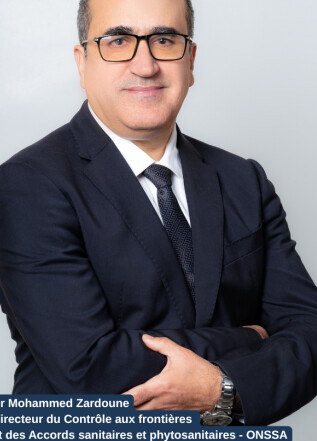
Dr Mohammed ZARDOUNE
Director of Border Control and
Sanitary and Phytosanitary Agreements (ONSSA)
and Dr Hicham ALIBOU
Head of the Animal Products Division
at the Food Control Directorate (ONSSA)