




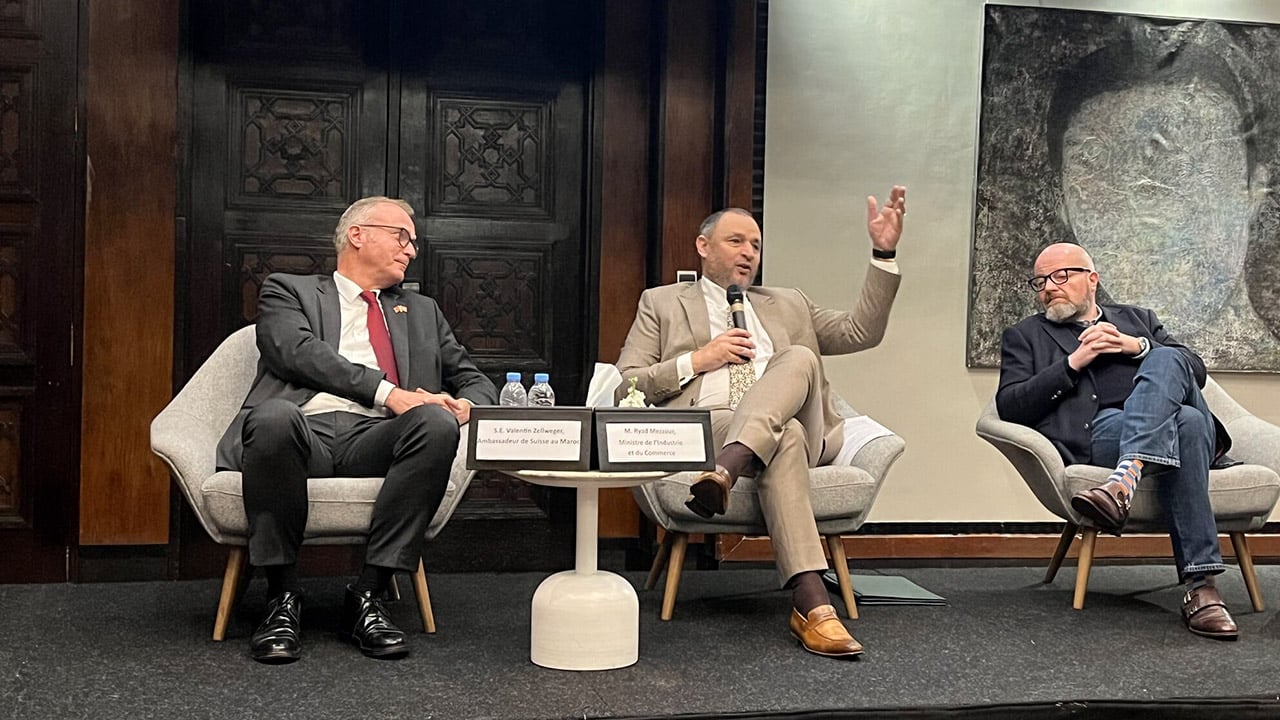
The CCSM opens the debate on CBAM with Minister Ryad Mezzour
On Friday 14 March 2025, the Swiss Chamber of Commerce in Morocco welcomed a packed room of members, partners and guests to the conference-debate on the theme: “Decarbonising industry: successfully adapting to CBAM standards to win the European market”. Led by the Minister of Industry and Trade, Mr Ryad Mezzour, in the presence of His Excellency Mr Valentin Zellweger, Ambassador of Switzerland to Morocco, and a panel of experts, this event, moderated by Ms Kawtar Raji, Secretary General of ASMEX (Moroccan Exporters’ Association), was an opportunity to demystify the requirements of the Carbon Border Adjustment Mechanism (CBAM), which will apply to manufacturers from 2026.
- Date
- Tuesday 18 March 2025
The discussions also focused on identifying concrete levers for action to reduce the carbon footprint of Moroccan manufacturers. On this subject, the Minister notably stated: “With more than 3,000 hours of sunshine a year and a coastline rich in wind resources, Morocco provides clean and competitive energy, helping manufacturers to comply with CBAM requirements without increasing costs”. A boon for the Moroccan economy, which is doing everything it can to “decarbonise”, with ambitious policies and dedicated financing mechanisms.
The Swiss Chamber of Commerce in Morocco’s conference-debate aroused considerable interest, as illustrated by the contributions of partners such as LafargeHolcim, SGS, BMCI and GIZ. It also enabled several experts, business leaders and public-sector players to share their visions and initiatives regarding adaptation to CBAM standards.
As a reminder, CBAM is a European regulatory instrument that aims to subject products imported into the European Union to carbon pricing equivalent to that applied to European manufacturers of these products. The primary aim of this mechanism is to combat carbon leakage, in a context of heightened climate ambition at European level. The entry into force of CBAM, scheduled for 1st January 2026, will certainly have an impact on Morocco, 65% of whose exports go to Europe.
Take your business international
Join a network of leading, forward-thinking executives and business leaders to accelerate your bilateral business opportunities.
Become a member