










Swiss know-how serving Moroccan infrastructure
“Infrastructure: which major projects to improve Morocco’s attractiveness and which avenues for cooperation with Switzerland?”. That was the theme of the new webinar organised by the CCSM on 24 June. The meeting, which brought together several experts, reviewed Morocco’s major infrastructure and the contribution of Swiss companies in terms of know-how.
- Date
- Monday 19 July 2021
Investment in infrastructure has been one of Morocco’s key priorities for improving its competitiveness. Yet needs and ambitions remain enormous, attracting the interest of operators in the sector from all four corners of the world, and notably from Switzerland. This was the subject of the webinar on the theme “Infrastructure: which major projects to improve Morocco’s attractiveness and which avenues for cooperation with Switzerland?” organised by the Swiss Chamber of Commerce in Morocco on 24 June.
Moderated by our President, Christophe de Figueiredo, the meeting featured several experts and stakeholders from the sector: Adil Bahi, Director of Strategy and Resources at the Ministry of Equipment, Transport, Logistics and Water; Abdellatif Nasserdine, Managing Director of Infra Invest; Alae Lalami, Director of the Concrete, Aggregates and Roads business of LafargeHolcim Maroc; and Faiz Oumghar, Regional Manager NWCl Africa and Managing Director Leica Geosystems Morocco.
Long-term strategies
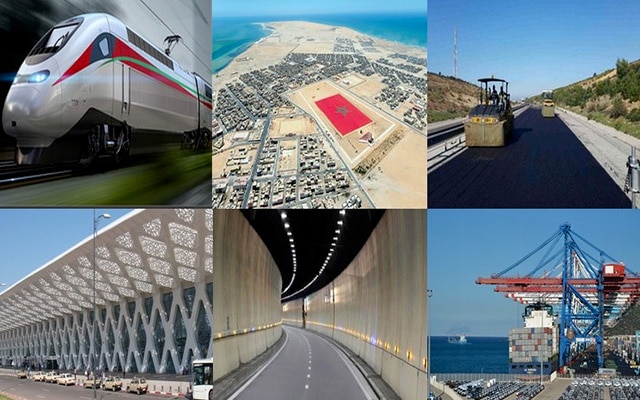
For several decades now, Morocco has been working to deliver large-scale infrastructure projects. The Kingdom has drawn up sectoral plans offering significant sources of growth, notably the Roads Plan 2035, the National Strategy for the Development of Logistics Competitiveness 2030, the reforms undertaken and the liberalisation of the various modes of transport, as well as the National Water Plan, the Rail Plan 2040 and the National Port Strategy 2030. “It is very important to stress that these are long-term projects that transcend government terms of office. We do not work with a short-term mindset. Rather, we are part of a national vision”, Adil Bahi, Director of Strategy and Resources at the Ministry of Equipment, Transport, Logistics and Water, stated at the outset.
In terms of road infrastructure alone, Morocco has a network of 57,334 km, with motorways stretching over 1,800 km, 1,334 km of expressways and 44,215 of paved roads. A network density that makes it a champion both in Africa and in the Arab world. Looking ahead, the Kingdom is rolling out a Roads Plan 2035, one of whose main focuses is the modernisation of the road network. The aim is to improve service quality and to develop 7,000 km of national roads, 2,000 km of expressways, 45,000 km of rural roads and 2,000 km/year of rehabilitated roads. The objective is ambitious: to double current capacity.
A boost to port capacity
Maritime transport is not to be outdone. Several port projects are under construction, such as Nador West Med, which has reached a completion rate of 52%. The same goes for the Dakhla Atlantic port project, launched with a 2027 deadline. In addition, the new Kénitra Atlantic port project will back onto the port of Casablanca, thus providing additional capacity. Port activity will also be supported by extension projects at several of the country’s ports.
“PPPs, the key to meeting financing needs”
While Morocco has opted to finance its road projects from its government budget, this option is not viable for other sectors. “The Public-Private Partnership (PPP) model has proven its effectiveness in sectors such as energy. Today, with the ambitions set out in the New Development Model recently presented to HM the King, the State should turn to PPPs to finance projects in the health and education sectors”, stressed Abdellatif Nasserdin, Managing Director of Infra Invest.
At the same time, since this type of partnership is now available to local authorities, whose investment needs are still enormous, they should open up further to private operators to find financing solutions suited to their needs.
Swiss know-how
In terms of infrastructure, Morocco has always been able to count on Swiss experience and know-how. The cement maker LafargeHolcim, present in Morocco for 90 years, has been the main supplier for many flagship projects such as the port of TangerMed
The expertise of Sika Maroc, which offers innovative construction solutions, has contributed to flagship projects such as the Moulay Hassan bridge, the Nadorwest port, the tunnel on the Marrakech/Agadir motorway and the Grand Theatre of Rabat.
Swiss expertise in Morocco is also technological, with Leica Geosystems, the world’s leading manufacturer of airborne sensors for photogrammetry and mapping applications. Its expertise has made it possible to reduce maintenance costs and produce data enabling better operation of several Moroccan infrastructure assets.
In view of the excellent relationship between Switzerland and Morocco and their joint achievements in infrastructure, cooperation between the two countries, driven and supported by the CCSM, has a bright future ahead.
Take your business international
Join a network of leading, forward-thinking executives and business leaders to accelerate your bilateral business opportunities.
Become a member