













Solvency and payment default: how to come out on top?
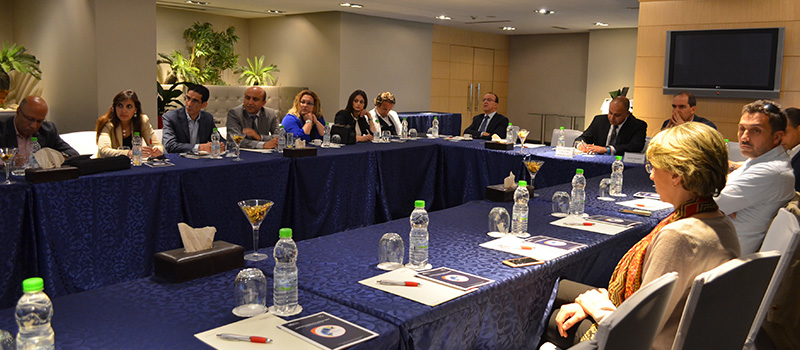
Before an audience of guests keenly interested in the issue of Very Small Enterprises (VSEs) and the risk of payment default, the consultancy Inforisk and its partner AIS led, on 25 April, the CCSM conference-debate on scoring and the risk of payment default: “VSEs: how to target them effectively while limiting counterparty risk?”. A meeting that placed issues dear to companies, such as solvency, at the heart of the debate.
- Date
- Tuesday 2 May 2017
“Very Small Enterprises account for almost 96% of the national economic fabric,” announced Mr Amine Diouri, Head of SME Studies at Inforisk, at the outset. Today, these high-potential businesses are suffering a sharp fall in turnover. A major problem associated with cash flow. “The weather forecast for VSEs is stormy. VSEs’ working capital requirements have risen by 40 points, which is very significant. And 40% of business failures in Morocco are due to unpaid invoices,” explained Mr Diouri. “To cope with this situation, VSEs turn to their own equity and to partners’ current accounts to cover two thirds of their needs. Inter-company credit comes third, followed by bank financing, which accounts for only 9% of VSE financing,” he continued. These companies thus face the difficulty of diversifying their sources of financing.
How to manage the risk of non-payment?
The consultancies Inforisk and AIS have recently developed a scoring tool to prevent companies’ risk of non-payment. Called SCORATING, “this solvency score will allow any company to determine precisely whether its business partner, customer or supplier presents a major risk of payment default over a horizon of 1 to 12 months”. Through the Analytix platform, “which also takes qualitative data into account with indicators such as indebtedness, liquidity, etc., Inforisk and AIS offer to significantly limit any risk of non-payment,” noted Daniel Torrents, Representative of the consultancy AIS. They present companies’ solvency score over a three-month horizon according to a defined sectoral ranking, from green to red. Companies with a very low risk of payment default (76-100) are in the green, while those showing a very high risk of payment default (0-25) are further into the red.
A network of professionals has also been formed on the Analytix platform, which can rate companies and also exchange views on all solvency-related issues.
What he said…
I would like to thank the Swiss Chamber of Commerce in Morocco for this invitation. The session aroused a great deal of interest and I think that is quite normal. Today, the problem of late payment is real; it is one of the main causes of business failures. We also live in the era of Big Data, with a maximum of data at our disposal, and our objective is to obtain the most relevant information. The scoring we have developed is one tool among others that will allow business leaders to make the best possible decision. Amine Diouri , Head of SME Studies at Inforisk
It happened at the CCSM
“To Each Their Own Everest” with Nacer Ben Abdeljalil
It was in the company of Mr Nacer Ben Abdeljalil, the first Moroccan to have climbed Everest and crossed the North Pole, that the CCSM brought its members together on 11 April at the Mövenpick Hotel Casablanca for a round table on the theme “To Each Their Own Everest”. The choice of this theme was no accident. It made it possible to discuss with the audience the power of surpassing oneself as a driver of professional success. Mr Nacer Ben Abdeljalil, a former financier turned adventurer and speaker, discussed with the members the importance of sporting values by analogy with those of the business world.
Passionate about sport from a very young age, Nacer Ben Abdeljalil had always wanted to achieve a sporting feat, and it was during a trek in China that he thought of climbing to the summit of Everest. A challenge to which he devoted a great deal of preparation, notably with the Seven Summits challenge, climbing the highest peaks on each continent (Kilimanjaro, McKinley, Aconcagua, etc.).
After the effort, the reward. On 20 May 2013 at 5.50 a.m., he became the first Moroccan to climb the highest summit in the world, and in the finest possible way. His strength? Values and lessons such as patience, courage, humility, confidence, perseverance, the importance of setting goals and doing everything to achieve them. One of his inspiring quotations: “With ordinary talent and extraordinary perseverance, all things are attainable.” by Thomas Fowell Buxton.
I was delighted to come and share with them my passion for mountains and mountaineering, as Switzerland is a country most of whose territory is covered by mountains. I also wanted to share with the audience the link between the values of mountaineering, and of sport in general, and those of business, to convey the message “To Each Their Own Everest”, because the essential thing is to make one’s own the values of perseverance, courage, ethics and above all goodwill. A word from Mr Nacer Ben Abdeljalil
Take your business international
Join a network of leading, forward-thinking executives and business leaders to accelerate your bilateral business opportunities.
Become a member