





Rail transport and sustainable mobility
Since COP22, Morocco has been conducting studies aimed at making its infrastructure more attractive, more complementary and more competitive while responding to the growing movements of people and goods and …
- Date
- Thursday 19 October 2017
ABB promotes sustainable mobility in Morocco
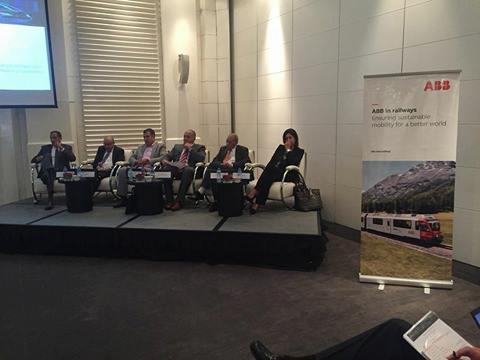
On Wednesday 11 October at the Hyatt Regency hotel in Casablanca, the Swiss Chamber of Commerce in Morocco, in partnership with ABB, organised a conference-debate on the theme “Rail transport and sustainable mobility”. A key meeting for Morocco’s sustainable development, attended by His Excellency the Ambassador of Switzerland to Morocco, Mr Massimo Baggi, alongside the President of the CCSM, Mr Mehdi Benzaari.
Morocco is more determined than ever to make sustainable mobility a fundamental issue of its transport policy. That is the conclusion that could be drawn from the conference-debate organised on 11 October by the CCSM in partnership with ABB, the global leader in power and automation technologies, on the theme “Rail transport and sustainable mobility in Morocco”. During this meeting, the master plans presented by the representatives of the Ministry of Equipment, Transport, Logistics and Water, the Federation of Transport and Logistics, the National Railways Office (ONCF), the Rabat-Salé Tramway Company, Casa Transport and the Research Institute for Solar Energy and New Energies (IRESEN) shed further light for the participants on the Kingdom’s ambitious sustainable mobility projects, but also on the tailor-made solution offered by ABB in this field.
Sustainable mobility at the heart of Moroccan policy
Since COP22, Morocco has been conducting studies aimed at making its infrastructure more attractive, more complementary and more competitive while responding to the growing movements of people and goods and reducing their impact on the environment. “For more than a decade, our country has undertaken a number of major projects aimed at developing sustainable mobility. Among these projects is the Greater Casablanca development plan to 2030, which devotes a large share of its budget, namely 33.6 billion dirhams, to developing sustainable transport, notably through the construction of a public transport network including four tram lines”, recalled the representative of the Ministry of Equipment, Transport, Logistics and Water, Mr Hicham Abdelaziz Moumni, during his speech. Still in the field of transport, the same ministry has launched a new 2017-2021 strategy for greater accessibility and efficiency, but above all one that ensures respect for the environment. And that is not all! More generally, it also aims to modernise transport.
However, if so many ambitious and innovative projects have been dedicated to mobility as part of a general sustainable development policy at national level, it is because “transport, as explained by Mr Rachid El Mrabet, Director of Calls for Projects and Innovation at IRESEN, is the largest consumer of energy in Morocco. Road transport alone accounts for 88% of the transport sector’s energy consumption, of which 35% is for private vehicles and 43% for the road freight fleet in circulation”. Succeeding him on the rostrum to present the achievements and projects of the Rabat-Salé Tramway Company, Ms Loubna Boutaleb, in her capacity as Managing Director, presented the works under way to extend the Rabat tram service (which carries a minimum of 120,000 passengers a day, Ed.). “The two current lines of the Rabat tramway will benefit from major extensions, in addition to the three new additional lines that will be set up”. On this occasion, the Director also highlighted the measures taken by the City of Rabat to launch its Urban Travel Plan (PDU), which will cover the period 2017-2024. A Plan that provides for the introduction of four electric bus lines. Two other major projects are also planned by the company, namely the creation of multimodal hubs and service to the future Rabat Agdal high-speed (LGV) station.
As for Casa Transport, it is involved in several road infrastructure projects, namely the Azbane underpass, the Almohades underpass and the Sidi Maarouf cable-stayed bridge, which is still under construction. “These infrastructures, as demonstrated by the Director of Studies and Development of Casa Transport, Mr Aziz Berrahou, will help to transform the city and bring modernity and sustainable mobility to it.”
Rail, the backbone of sustainable mobility
In the following presentations, the ONCF representative, Mr Said Chandid, Director of Strategy and Communication, stressed that sustainable mobility is a necessity because climate change affects mobility needs and options. According to him, “rail is the route that best meets our expectations in terms of sustainable transport. It has its advantages. Rail ensures safety, environmental preservation and energy savings. That is why, today in Morocco, we are gradually moving towards an urban transport system in which rail forms the backbone”. This justifies several ambitious projects by the Office, including the launch of a study to draw up a national mobility master plan for 2025 and 2035, the Rail Plan 2040, the RER and the LGV (high-speed line). Indeed, this roadmap aims to define the future configuration of the rail network, namely conventional lines, high-speed lines and regional services, in order to support Morocco’s socio-economic development and contribute to improving the competitiveness of the productive sectors.
ABB, for tailor-made solutions
It was with great interest and attention that the ABB representatives, Mr Khaled Torbey, Managing Director of ABB Morocco, Mr Thierry Lassus, Rail Industry Network Infrastructure & E-bus Global Head (ABB Switzerland), and Emmanuel Cuvillier, EMEA Product Executive (ABB France), followed the presentations of each of the entities present at the conference-debate. On this occasion, they did not fail to express their willingness and ambitions to collaborate with Morocco on sustainable mobility. Mr Emmanuel Cuvillier presented ABB’s solutions to the main transport operators, inviting them to become involved and also to commit more to sustainable mobility. ABB has long been developing sustainable transport solutions. Its innovations have the potential to transform the urban environment for the benefit of all, through innovative and efficient technologies and charging infrastructure for electric vehicles. It was with this in mind that Mr Thierry Lassus presented ABB’s most recent innovation, unveiled in Geneva: an ultra-fast charging system for high-capacity electric buses. This system delivers a 15-second recharge at bus stops, thus providing enough power to reach the next stop. For electric vehicles, ABB manufactures 50 kW direct-current charging stations, which will soon be upgraded to 150/300 kW and which are compatible with all vehicles using the CHAdeMO 1.0 and CCS2 standards. Better still, with the TOSA system, electric buses run without overhead contact lines and recharge at certain stops in just 15 seconds. 100% electric buses equipped with this system are currently running in Geneva. Thanks to the quality of its offering, ABB has equipped 50 Volkswagen and Audi dealerships as well as their new headquarters in Roissy. Considerable experience that the technology leader ABB wishes to make available to Morocco, in order to contribute to the development of sustainable mobility in the Cherifian Kingdom through its innovative solutions to reduce energy consumption and greenhouse gas emissions in road, rail and maritime transport.
It was on this promising note that the meeting came to an end. To keep up this momentum, an appropriate framework for consultation and exchange between public authorities, local authorities and the private sector should be organised fairly often. With the organisation of this conference-debate, the Swiss Chamber of Commerce has set the ball rolling. Other initiatives will be welcome in order to exchange views on the best solutions to meet Morocco’s transport needs today and tomorrow.
This conference-debate contributes to the sustainable development momentum established in the city of Casablanca through several projects, such as the introduction of a public transport network with a rather special parking policy, or the electric network and the BHNS (bus rapid transit, Ed.). All of these projects can only reduce the harmful effects of greenhouse gases in the city… We congratulate the CCSM and ABB on the successful organisation of this day. Mr Aziz Berrahou , Director of Studies and Development, Casa Transport
The Rabat-Salé Tramway Company is part of a sustainable development approach for the urban area. And in this respect, the tramway very quickly established itself as the ideal solution. However, we remain open to any other proposals, with the sole ambition of continuing to modernise the two cities. This kind of initiative is commendable. It should therefore be repeated, because it allows the various transport players to meet and present the progress of their projects, which meet the national objective of sustainable development. This conference-debate is also an opportunity to draw inspiration from other countries and to benefit from their technological advances and their experience of the same issues that we face. Ms Loubna Boutaleb , Managing Director, Rabat-Salé Tramway Company
What has been developed in this room throughout the day amply proves that we are at the heart of sustainable mobility. We congratulate the CCSM on this organisation. It succeeded in bringing transport decision-makers and operators around the same table to discuss the potential challenges of sustainable transport, and also in demonstrating Morocco’s openness to all proposals for innovative sustainable transport solutions. Mr Thierry Lassus , Rail Industry Network Infrastructure & E-bus Global Head, ABB Switzerland
Take your business international
Join a network of leading, forward-thinking executives and business leaders to accelerate your bilateral business opportunities.
Become a member