








Foreign Exchange Regulations: what’s new in 2017
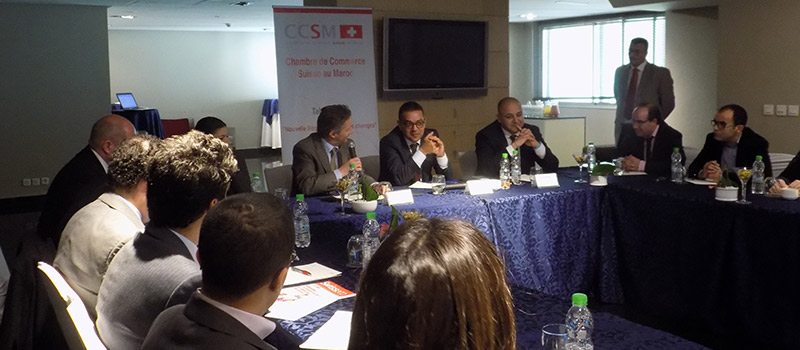
Some thirty guests, made up of members, diplomatic representatives and journalists, were present on 14 December 2016 at the Mövenpick Hotel in Casablanca for the round table organised by the Swiss Chamber of Commerce in Morocco. With Mr Hassan Boulaknadel, Director General of the Office des Changes (Foreign Exchange Office), as guest of honour, the event focused on the new Foreign Exchange Regulations, which have been redesigned to make them easier for economic operators to use.
- Date
- Thursday 9 February 2017
“Thanks to its economic stability and the resilience of its banking system, Morocco continues to strengthen its anchoring in its regional and international environment”. And it is in this spirit of openness that the need to make the Foreign Exchange Regulations more flexible and more accessible was felt and acted upon by the Office des Changes, under the leadership of Mr Hassan Boulaknadel. “This new flexibility mechanism consists of widening the dirham’s quotation basket, and this presupposes a deeper foreign exchange market with an overhaul of its entire logic; in this environment, economic operators need more flexibility,” explained Hassan Boulaknadel.
Liberalisation and easing
Faced with the outdated state of the legal texts governing the Foreign Exchange Regulations and the disparate nature of the regulatory circulars, among other things, which made access to information very complex for operators, the Office des Changes published in January 2017, after several months of work, the General Instruction on Foreign Exchange Operations. A new version that is more flexible and better suited to the needs of economic operators. With this in mind, the Office des Changes has taken several measures, notably the harmonisation of advance payment for imports of goods and services, with a ceiling of 200,000 dirhams and a down payment set at 30%. Other measures include the provision to persons outside Morocco, the liberalisation of transfers for the remuneration of foreign staff, the extension of the deadline for repatriating proceeds from service exports from 60 to 90 days, and the possibility of obtaining financing through foreign currency inflows. All these measures will make our members’ daily lives easier and develop trade between Morocco and Switzerland.
The new regulations, through the General Instruction of the Office des Changes, are therefore presented in a single document that places a premium on concision. It goes from 425 to 240 pages, and from 807 to 215 articles. For more information, visit http://www.oc.gov.ma/portal/.
It happened at the CCSM
In partnership with the Caisse Interprofessionnelle Marocaine de Retraite (CIMR, Moroccan Interprofessional Pension Fund), the CCSM organised on Friday 2 December, at the Mövenpick Hotel in Casablanca, a round table entitled “Pension crisis: what role for supplementary pensions?”, led by Mr Khalid Cheddadi, Chairman and CEO of CIMR, who declared at the end of the event:
“CIMR’s new status follows the obligation to comply with the provisions of Law 64-12 establishing (sic) the insurance and social security supervisory authority. This new status as a mutual pension company requires us to comply with a certain number of standards, in terms of financial management but also criteria for the sustainability of indicators, etc. Through this change, we have improved the operation of our scheme with new benefits such as the death benefit lump sum, the lump sum paid to the heirs of single members…
I was very pleasantly surprised by the number of guests. This shows that the CCSM knows how to mobilise its members around subjects that matter to them; the exchange that followed demonstrates quite clearly their interest in and knowledge of the subject.”.
Take your business international
Join a network of leading, forward-thinking executives and business leaders to accelerate your bilateral business opportunities.
Become a member