





Exchange rate regime reform: Bank Al Maghrib opens the debate
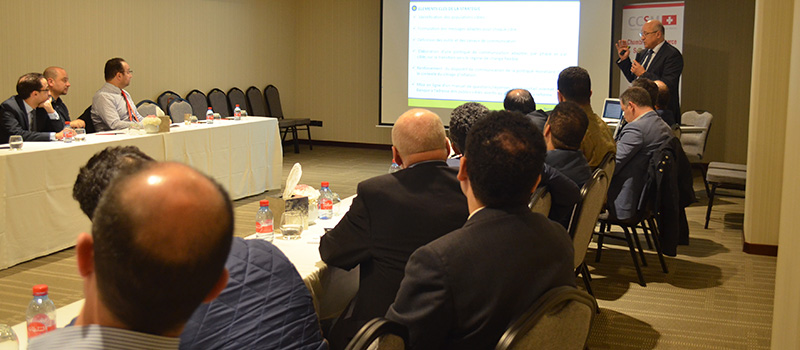
On 22 March 2017, the Swiss Chamber of Commerce in Morocco invited its members to the Grand Mogador City Center Hotel in Casablanca to discuss the exchange rate flexibility announced by Bank Al Maghrib for the second half of 2017. Mr Mounir Razki, Director of Monetary and Foreign Exchange Operations at the central bank and guest of honour at this event, presented to the audience the benefits of this reform for the Kingdom.
- Date
- Friday 28 April 2017
Consolidating the competitiveness of the Moroccan economy and boosting the growth of the financial sector through a more flexible exchange rate regime: these are the objectives that Bank Al Maghrib (BAM) has set itself through the reform announced for the next half-year. A transition that requires taking external risks and imbalances into account, based on criteria such as the peg to a basket of currencies with a weighting set at 60% for the euro and 40% for the dollar, compared with 80% and 20% previously. “Ultimately, the exchange rate will no longer be an anchor; it will be volatile and the anchoring will be on the inflation rate,” explained Mr Razki, BAM’s Director of Monetary and Foreign Exchange Operations. The other criteria for exchange rate regime flexibility are the widening of the fluctuation bands. It will also be necessary to define the terms of the central bank’s intervention and to communicate this policy to operators.
The reasons for a transition
“For some twenty years, Morocco has pursued an increasingly extensive policy of economic openness. We have signed 55 free trade agreements with several countries, and a more flexible, more liberal mechanism is needed to support this direction,” argued Mr Razki. Another ambition is to establish Casablanca as a regional financial hub so that foreign investors find the same environment there as in Dubai and London, at every level: regulatory, tax, etc. However, the exchange rate is not the only factor in improving competitiveness; “it must be accompanied by actions, training and reforms in order to improve productivity,” he continued.
However, in the event of major exogenous shocks, it is important for Morocco to be able to preserve its foreign assets so that adjustments are made through the exchange rate and not through the assets.
The advantages of economic liberalisation
The reform would allow, for example, financial liberalisation with the gradual lifting of foreign exchange restrictions. One example is the capital account, fully open to non-residents. For residents, it will be a partial opening which will initially concern operators with well-controlled risk management systems and governance mechanisms.
What he said…
We decided to organise this event because the flexibility of the dirham is a major event for the country’s economy. It is a structurally important transition that will affect the life of companies but also that of all Moroccans. In my view, it is a unique opportunity for Morocco; it is of course an approach that involves a certain number of risks, but the opportunities for the Moroccan economy are much greater. Moreover, the Kingdom’s economic indicators are very satisfactory, so the timing chosen by BAM to make this change is very opportune. Mehdi Benzaari , President of the CCSM.
It happened at the CCSM
How to manage your talent?
Specialising in recruitment, the firm BatenborcH International Maroc, a new member of the CCSM, was the Chamber’s guest at the round table held on 28 March at the Mövenpick Hotel Casablanca on the theme: “The Shadow epidemic: the hidden disease that destroys teams and companies, and the science to cure it.”. Ms Sophia SEBTI and Mr Anthony MARTINS de NOBREGA, the speakers from BatenborcH, first shared their respective experiences with the guests before giving them the keys to managing their talent better. Their method? The “PRINT®” technology developed by Dr Paul Hertz, who defines it as “the only method based on available data to identify what drives people’s actions.”. And he continues: “if you want your company to be unique and among the best performing, your management, your training, your directives and your strategies must take into account the Invisible Motivators® of the human factor (the reasons that drive their actions, not their behaviour).”
We very much appreciated the small-group format, as it encourages exchange and allows us to get feedback from the participants. They are motivated by the theme, and this generated intensive exchanges that we find interesting for improving our clients’ day-to-day lives. BatenborcH International Maroc.
For more information on the subject, contact Ms Sebti at: s.sebti@batenborch.com.
Take your business international
Join a network of leading, forward-thinking executives and business leaders to accelerate your bilateral business opportunities.
Become a member