












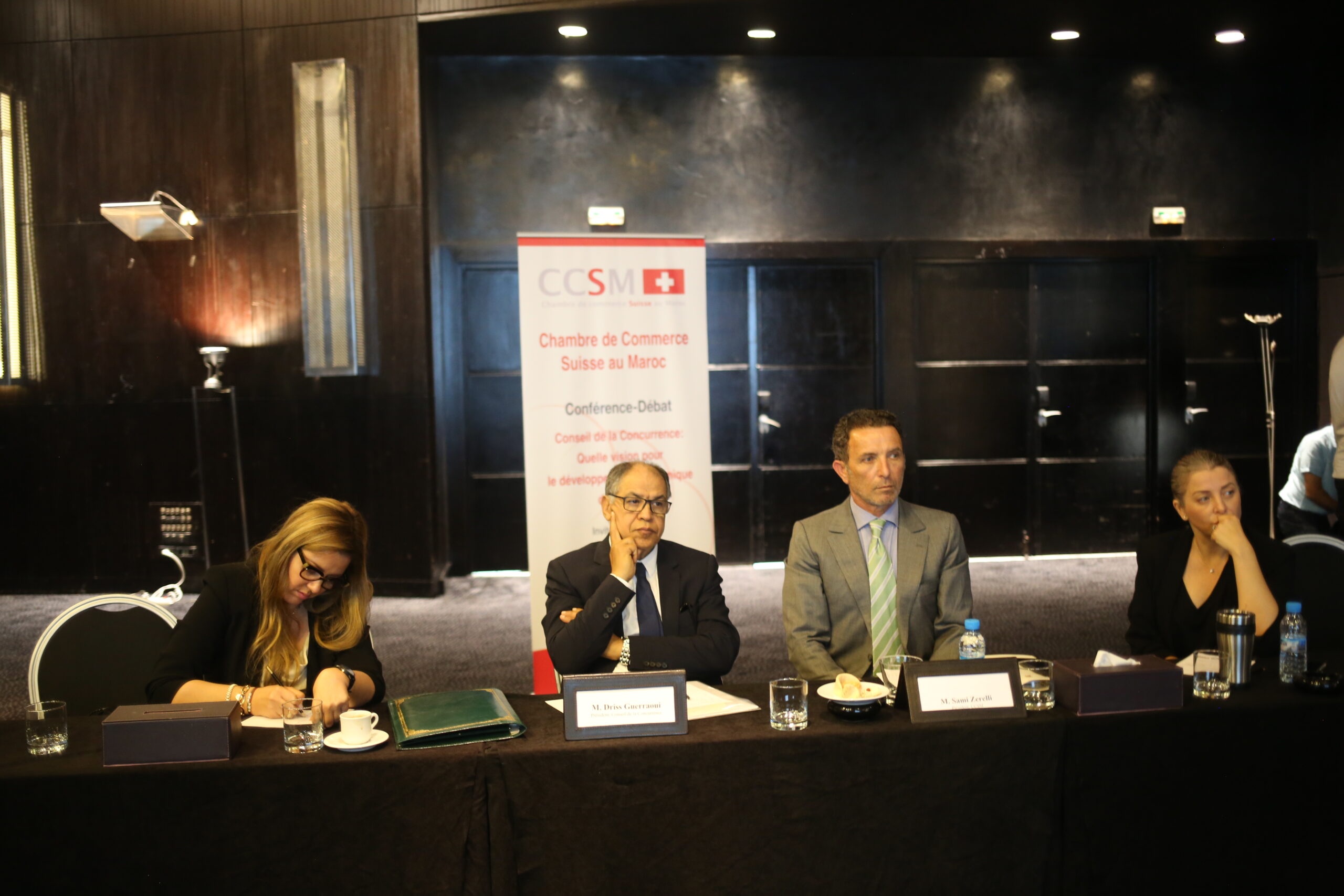
Driss Guerraoui, President of the Competition Council, guest of our round table
On Tuesday 23 July, the Swiss Chamber of Commerce organised a round table at the Sofitel in Casablanca entitled “ Competition Council: What vision for the …
- Date
- Thursday 25 July 2019
“The Competition Council has the power to impose sanctions on companies”
On Tuesday 23 July, the Swiss Chamber of Commerce organised a round table at the Sofitel hotel in Casablanca entitled “Competition Council: What vision for Morocco’s economic development?”. The event took place in the presence of Driss Guerraoui, President of the Competition Council (Conseil de la Concurrence) in Morocco. Invited by the CCSM as a specialist in the field, Mr Guerraoui presented to participants the missions of the institution he heads, its challenges and its ongoing projects.
“ In 2008, Morocco set up a Competition Council. The law now gives it three new powers: a power of investigation, a power of decision and a power of sanction.” It was with these words that Driss Guerraoui, President of the Competition Council, opened the debate on the current challenges of regulating economic governance in Morocco. Appointed by King Mohammed VI, Driss Guerraoui has headed this institution, which is responsible for combating abuses of economic dominance and unfair competition practices in Morocco, since November 2018.
Rethinking the foundations
First, the meeting gave Driss Guerraoui the opportunity to explain to CCSM members the origins of the Competition Council and to highlight its developments, but also the difficulties it faces. Although competition law has been applied in Morocco since 2002, the Competition Council was only created in Morocco in 2008, and for years was limited to an advisory role. “In 2014, a law amending the prerogatives of the Competition Council was passed, thereby strengthening its powers”, stressed Driss Guerraoui. He added: “We are now on the road to real change. The Council has today strengthened its foundations and has broad powers of investigation and decision over all anti-competitive practices and abuses in the economic sphere”. As a reminder, in addition to the President, the current Council is made up of 12 members appointed by decree of the Head of Government.
New fields of action and decision
Among its new fields of action, the Competition Council can now take up a case on its own initiative without waiting for a referral from the government. Conversely, companies can do the same. “The Competition Council has the power to impose sanctions on companies that do not comply with competition law, which can amount to up to 10% of the offenders’ worldwide or national turnover ”, explained the President. Driss Guerraoui then presented the Council’s three essential missions: closely monitoring the behaviour of companies, monitoring market structure, and acting as an advisory body on public competition policy through constant legal and economic monitoring.
Ongoing projects
“Since the Council was created, we have had 105 pending cases and we have currently examined 80% of them”, said Driss Guerraoui. In addition to the missions, the conference was also an opportunity to take stock of the sensitive sectors on which the Competition Council’s actions are closely focused, such as e-commerce, hydrocarbons, medicines, tobacco and bureaux de change. According to Driss Guerraoui, the Council is currently working on several structural projects. “The first ambition is to establish a code of good conduct and a competition barometer based on a reliable reference framework that will make it possible to assess the level of compliance with competition rules. Its results will be published every year”, he explained. The President also mentioned the creation of a National Markets Observatory to fill the legal gap relating to certain sectors, and the roll-out of a public awareness campaign to further involve civil society and actively raise its awareness of competition issues.
At the end of the round table, the President of the Competition Council made a point of recalling that “ consumer protection remains inadequate in Morocco”. He concluded: “ We must seize this opportunity for improvement to promote a culture of competition and its good practices through the systematic application of the law, which remains our main tool. We are determined to give priority to prevention and to impose sanctions whenever anti-competitive practices are proven.”
Testimonials
Today, companies must meet several imperatives: produce more, produce better and produce more cheaply, in a context that is both socially and economically responsible. To be part of this dynamic, they need visibility. They need to operate in an environment that builds trust, with impeccable legal certainty. Faced with these new realities, States have only one option: to create the conditions to unleash the energies and productive forces of our economies. What Morocco needs today is to create economic governance that allows all those who want to invest and take risks to do so without any barriers, in a climate of fairness and equal opportunity. That is the raison d’être of the Competition Council. Driss Guerraoui, President of the Competition Council in Morocco
This conference was very important as it allowed us to engage in dialogue and convey the grievances of our economic operators to the Competition Council. With the 2014 amendment to the law, this Council has greater powers in terms of sanctions. We felt it was necessary to support it in reactivating its action plan and to share with it the realities we experience. This conference taught us to discuss things together. Today, unfair competition comes mainly from bad practices at local level. I remain convinced that improvement lies in the virtuous circle put in place by the Competition Council: prevention, control and sanction. Sami Zerelli, President of the Swiss Chamber of Commerce in Morocco
This conference is a very good initiative on the part of the Swiss Chamber of Commerce in Morocco. As a multinational with a subsidiary in Morocco, knowing that the Competition Council is active, independent and functional in the country reassures us about our investment. There is admittedly work still under way in Morocco today that must continue to evolve in the years to come, but the fact that there is a competition council with real powers to take up cases and impose sanctions regarding anti-competitive practices is very encouraging. Abla Benslimane, Corporate Affairs Director of Philip Morris International Maroc
As part of my research, I work on the field of entrepreneurship in Morocco. This round table provides insight into the ambitions and the economic business climate as well as the major structural projects to come. In my view, the Competition Council’s new prospects are a very good initiative. Better regulation of economic governance is the key to enabling Morocco to continue to be a dynamic trading platform between Africa and Europe, through large-scale projects. The efforts made to ensure respect for competition and good practices can only further stimulate foreign investment. Sara Yassine, Professor and Researcher in Economics and Management at Hassan II University, Morocco
Take your business international
Join a network of leading, forward-thinking executives and business leaders to accelerate your bilateral business opportunities.
Become a member