
















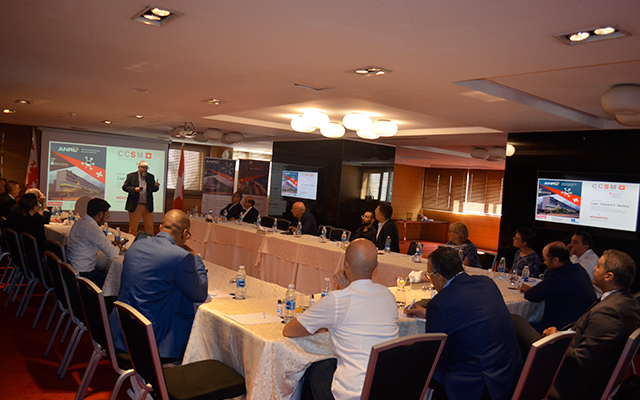
Conference: “The Human Factor serving operational and organisational safety”
On Tuesday 7 June 2022 in Casablanca, the Swiss Chamber of Commerce in Morocco (CCSM) organised a conference on the theme “The Human Factor serving operational and organisational safety”. Led by Edward E. Barbey and Stéphane Witschard, respectively a researcher in operational neuroscience and Managing Director of Inuk Safety Suisse, this meeting brought together executives and entrepreneurs from the Moroccan and Swiss economic sphere. Details.
- Date
- Monday 20 June 2022
Correcting decision-making and financial imbalance through operational neuroscience. That was the objective of the conference organised by the Swiss Chamber of Commerce in Morocco (CCSM) last Tuesday at the Mövenpick Hotel. The theme met with unanimous approval: one might as well invest in cognitive management processes to avoid the unfortunate events that could accidentally arise throughout a company’s life cycle. “When an organisation invests in this management system, it directly and indirectly avoids the setbacks that undermine its profitability and financial health”, explained Mr Barbey.
The human brain has several intrinsic characteristics that the individual calls upon at different cycles of their activity. The speakers focused all their attention on human brain activity and its impact on decision-making. “Did you know that the Challenger space shuttle accident was due to a management error? The 2008 financial crisis and the Boeing 737 Max accident also represent serious management errors ” illustrated Mr Barbey. He continued: “our approach is to support companies so that they manage to mitigate potential management-related risks”.
Cognitive load and vigilance
According to Mr Barbey, the definition of a company does not include the notion of safety, which is nevertheless important, regardless of the business sector or the size of the company. In aeronautics, for example, airlines are concerned by this management system, because a pilot’s lapse in vigilance will cause a human, material and financial disaster. This is why it is essential to understand how our brain works and its anatomy. This rule is universal and applies in all sectors. Decisions and the fate of the company are closely linked. “A decision taken at the wrong moment will wipe out its (the company’s, Editor’s note) existence”, he concluded.
For Mr Witschard, cognitive load disrupts vigilance and consequently leads to poor operational results. In other words, the transition from an inoperative level of vigilance to an operative level requires a variable transitional period, which depends on each person’s intellectual faculties. The educational transposition of the brain’s workload reveals how the brain’s algorithms function, and their proper functioning enables managers to make their business more profitable.
What they said…
Christophe De Figueiredo, President of the CCSM
“After the Covid-19 pandemic, waves of resignations and professional disengagement appeared. We chose this theme because it is in terms of the human factor that the shoe pinches”.
Jaouad Boutahar, Lecturer-Researcher, EHTP
“Today, more than ever, we need to establish a leadership that respects human specificities in order to achieve excellent results”.
Stéphane Witschard, Director at Inuk Safety Suisse
“The importance of this subject lies in raising awareness of the situation in developing the human factor, in order to reduce the risk of accidents in companies”.
Take your business international
Join a network of leading, forward-thinking executives and business leaders to accelerate your bilateral business opportunities.
Become a member