









CCSM: a ftour to promote the circular economy
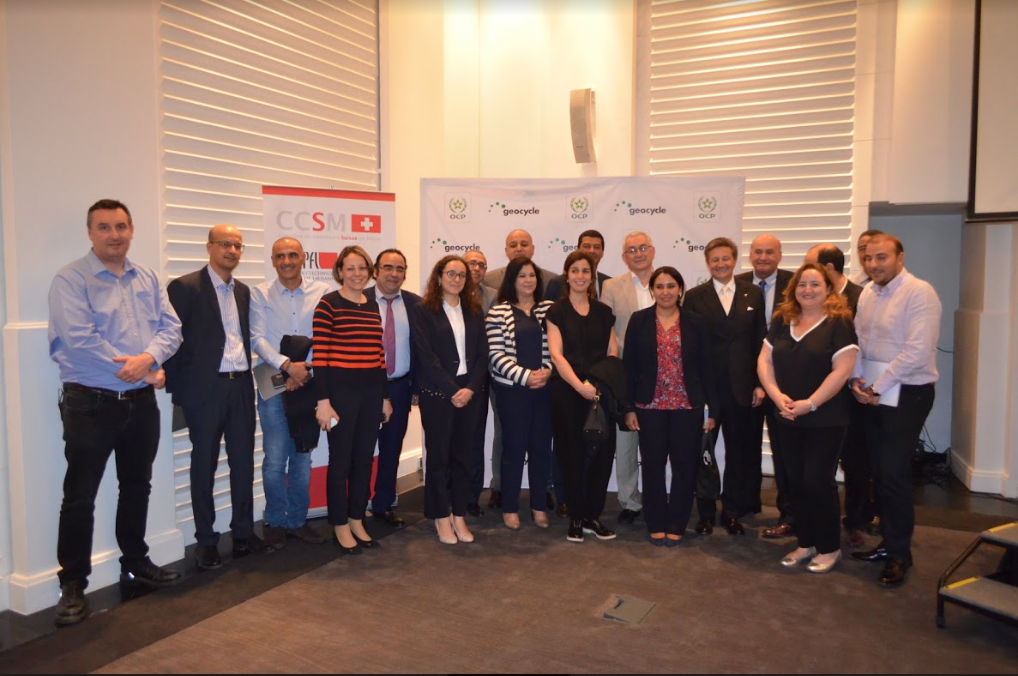
The Swiss Chamber of Commerce in Morocco organised, on 24 May at the Hyatt Regency hotel in Casablanca, a ftour debate on the theme “The Sustainable Development Goals and the Circular Economy: New opportunities for businesses”. A powerful and informative occasion on this new concept!
- Date
- Tuesday 17 July 2018
What economic model can make development on our planet sustainable? This was the main question at the ftour debate organised by the Swiss Chamber of Commerce in partnership with the EPFL Alumni Morocco Association (École polytechnique fédérale de Lausanne), on 24 May in Casablanca, on the theme “The Sustainable Development Goals and the Circular Economy: New opportunities for businesses”. Beyond the purely economic aspect, the question arises above all from the point of view of the sustainability of development, and even of survival! “Since the 1970s, humanity has exploited more than 30 million tonnes of materials extracted from the earth, a volume that exceeds one and a half times what the earth can provide. Humanity should learn to manage natural resources. Otherwise, we risk endangering the development of our countries, of the world and therefore of businesses ,” warns Prof. Bruno Oberle, Head of the Chair of Green Economy and Resource Governance at the École polytechnique fédérale de Lausanne. Economic players who today indulge in overproduction and overexploitation will find themselves handicapped in a few decades by the scarcity, or even the disappearance, of resources. For the economist, 2050 will be the last year in which we can draw on our planet’s natural resources at a reasonable cost. However, this prospect is not inevitable. “While in the energy sector we are turning to renewable energy, for everything else the beginnings of a solution lie in the circular economy,” the economist reassures. But what is the circular economy? An operational model of sustainable development, this system enables the creation of economic, social and environmental value, at both microeconomic and macroeconomic level, by proposing a new circuit for raw materials. Instead of the classic “extract, produce, consume, discard”, the circular economy proposes “extract/recycle, eco-design, produce, consume, collect, recycle”. From an economic point of view, this certainly imposes constraints but also presents great opportunities. Many large companies, particularly in industry, rely on the principles of the circular economy to reduce their costs.
In Morocco, the public authorities are taking an interest
Morocco is also part of this momentum. After congratulating the Chamber on its choice of this theme, “as fascinating as it is relevant”, HE Mr Massimo Baggi, Ambassador of Switzerland to Morocco, considered that “the sustainable development goals are making headway in Morocco, a country that is even setting an example, particularly in renewable energy”. And Ms Rajae Chafil, Director of Observation, Studies and Planning at the Secretariat of State for Sustainable Development and Secretary General of the National Council for the Environment, explained: “Our country is one of the few in the region to have adopted a national circular economy strategy for the period 2020-2030. Its ultimate goal? To ensure Morocco’s transition to a green economy by 2030”. According to her, “while the jargon of the circular economy is relatively new, the concept is an old one in Morocco, as shown by the recycled and repaired goods found in every souk in the country”.
The private sector is investing…
Public services are not the only ones making the circular economy a goal. Moroccan champions are applying the principles of the new model. The global phosphate giant, OCP Group, is a good example. The industrial company, which employs 23,000 people, has just set up a department dedicated to the circular economy. “We have adopted a global vision for the circular economy. It targets several objectives broken down into a number of projects,” explains Hanane Mourchid, the Group’s Head of Circular Economy. Among the group’s objectives are the use of 0% conventional water, the rehabilitation of mines, the recovery of by-products, and the reinjection of waste internally or externally. And while, for OCP, the circular economy is a positioning, for others, such as Geocycle, it is their core business. The specialist in waste recovery, first industrial and then household waste, has six centres for sorting and preparing alternative fuels to supply six client cement plants. “We draw inspiration from natural processes to find solutions that extend the life cycle of most waste as far as possible,” explains Hind Baddag, Subsidiary Director of Geocycle.
Verbatim:
As well as solving problems of natural resource management around the world, the circular economy offers a huge number of business opportunities. And Swiss companies have developed quite remarkable know-how in this field. Our aim is therefore to raise awareness of the issue but also to create a networking space between the various players in the system in order to find new business opportunities. Mr Mehdi Benzaari , President of the CCSM
Swiss companies can have a great deal of impact in promoting the circular economy in Morocco. We are a small country in size, but we are important from an economic point of view in Morocco. Switzerland is the fifth-largest foreign investor in the Kingdom. Many companies are established in Morocco and I believe they can contribute considerably to its development, both by creating jobs and by setting an example in terms of the circular economy and sustainable development. HE Mr Massimo Baggi , Ambassador of Switzerland to Morocco
If we do not learn to manage natural resources properly, we will endanger the development of our countries and of the whole world. And without efficiency and without achieving the sustainable development goals, we will not succeed. But in the face of this threat, there is a real economic opportunity. We must change the way we use natural resources, the type of products, our business models, our infrastructure… It is an enormous investment opportunity. It is a kind of Marshall Plan on a planetary scale. Prof. Bruno Oberle , Chair of Green Economy and Resource Governance, École polytechnique fédérale de Lausanne, Switzerland
Our presence here at the Swiss Chamber of Commerce is very important for us. It allows us to share our achievements related to the circular economy. It should be noted that our country has adopted its circular economy strategy and has begun implementing it. This 2020-2030 strategy aims to facilitate Morocco’s transition to a green economy by 2030. We are in the process of organising various circular economy chains, such as those for used tyres, used vehicle batteries, electronic waste, the recycling of end-of-life vehicles and construction materials, etc. So, even though it remains a developing country, Morocco has already laid the foundations of a circular economy. Ms Rajae Chafil , Director of Observation, Studies and Planning at the Secretariat of State for Sustainable Development and Secretary General of the National Council for the Environment
This event is close to our hearts, since it is about development and the circular economy, two values dear to OCP Group. We are very pleased to respond to this initiative, especially since in 2018 we decided to position ourselves on the circular economy to give new impetus to our sustainable development strategy. The concept has thus become a priority with a very ambitious vision, since we aspire to become the circular economy champion in our industry worldwide. This goes beyond environmental excellence to bring about responsible production and consumption tailored to needs, and to extend support beyond the production chain to reduce losses and waste and encourage the recycling of the latter. Ms Hanane Mourchid , Head of Circular Economy, OCP Group
Taking part in this event comes at just the right time to promote our business. As a leader in the recovery of industrial and household waste, we offer to manage our customers’ industrial waste and treat it properly so that it can be recycled or transformed into alternative fuels for cement plants. And at the Swiss Chamber of Commerce, many manufacturers and operators would like to find a secure solution for transforming their waste. Ms Hind Baddag , Subsidiary Director, Géocycle
Take your business international
Join a network of leading, forward-thinking executives and business leaders to accelerate your bilateral business opportunities.
Become a member