









An EPFL professor to debate energy geostructures
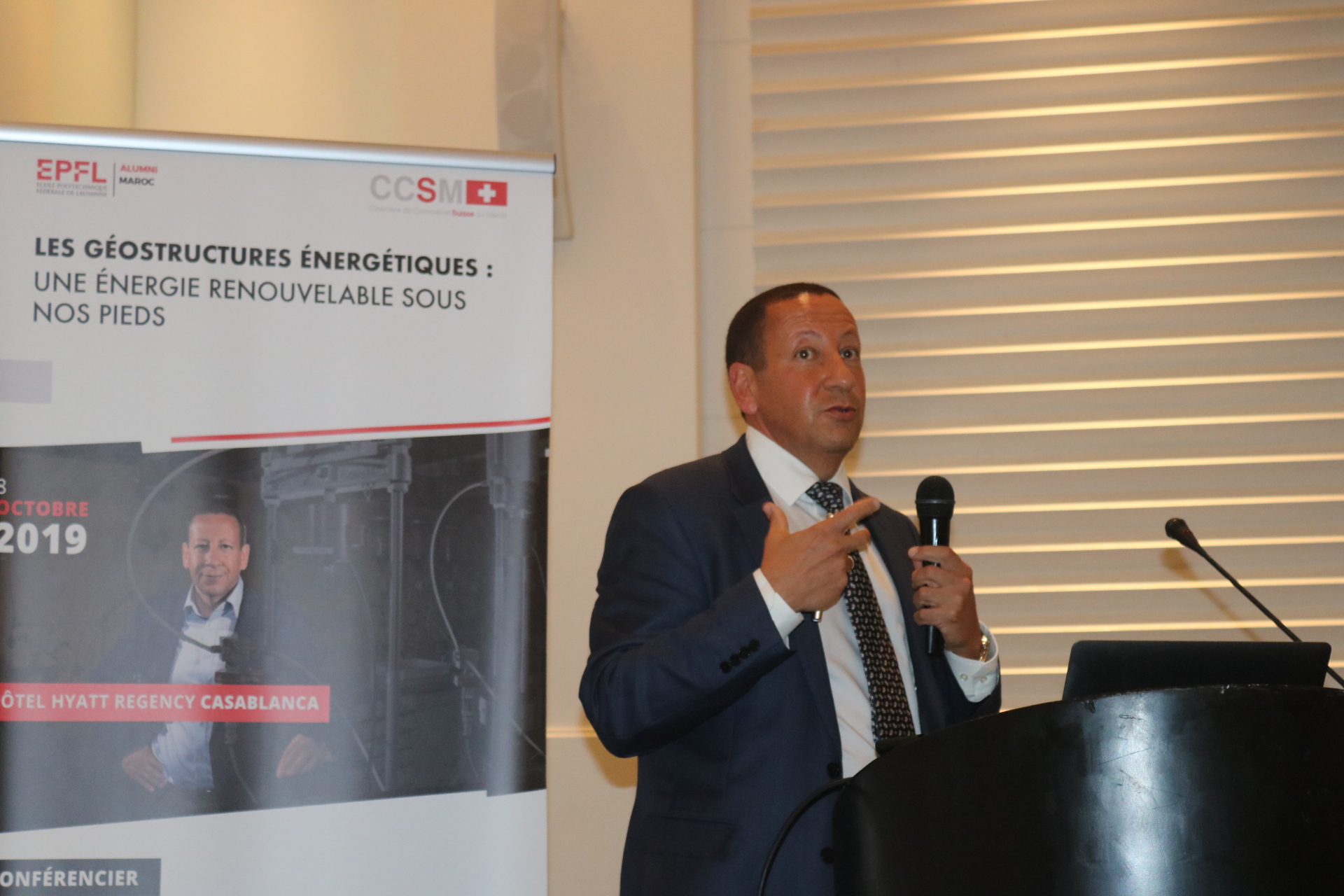
“Energy geostructures: renewable energy beneath our feet”. Such was the theme of the conference-debate organised by the EPFL alumni association, EPFL Alumni Maroc, and the CCSM. Led by Professor Lyesse Laloui, the event was attended by H.E. Mr Guillaume Scheurer, the new Ambassador of Switzerland to Morocco.
- Date
- Wednesday 23 October 2019
On Monday 14 October 2019, the Hyatt Regency hotel in Casablanca hosted a conference-debate on the theme
“Energy geostructures: renewable energy beneath our feet”. Organised by EPFL Alumni Maroc and the CCSM, the conference was led by Professor Lyesse Laloui, holder of the chair of soil mechanics, geo-engineering and CO2 storage at EPFL’s School of Architecture, Civil and Environmental Engineering, and director of the civil engineering section. The engineer places EPFL at the heart of innovation in the field of geotechnics and energy. Made up of energy geostructures, this technology aims to become a major player in the sustainable development of our cities and is positioning itself as a solid avenue for renewable energy in the building sector.
Economical and ecological
Can geothermal energy establish itself as an alternative, ecological and economical heating and cooling technology? Before an audience of around fifty people, this is the question that Professor Lyesse Laloui sought to answer in his presentation. “Even though it required years of research, the way energy geostructures work is relatively simple”, he explained. This technology operates as a closed circuit, which allows the accumulated heat to be stored via energy piles driven into the ground, and it is this same accumulated heat that is redistributed in winter. The entire technology is integrated into the walls and foundations of the building and accounts for 0.4 to 0.7% of the total cost of a project (10 to 15% of the cost of the civil engineering works). Moreover, the system makes it possible to save CHF 30/(m2*year) and is completely carbon neutral.
The Kingdom’s considerable potential
“Switzerland’s progress in this technology, combined with Morocco’s commitment to renewable energy, could lead to a multitude of projects including energy geostructures”, the professor said enthusiastically. Thanks to the major and continuous investments Morocco has made in wind and solar power, it is today the leader in Africa in renewable energy. The Kingdom also has strong potential for energy geostructures and is one of the only countries in the world to have mapped its energy needs. This solution, which is both economical and ecological and can be integrated into building structures, could easily be implemented. Indeed, energy geostructures can easily be integrated into all types of construction, including bridges and tunnels. For example, a 500 m energy tunnel can meet the heating and cooling needs of 185 apartments.
Testimonials
I find that the quality of the talk matched our ability to understand a very complex subject. It is a technology that may be of interest to Morocco, which is at the cutting edge of renewable energy technology. And I think that energy geostructures can thus provide an additional boost to the energy transition that Morocco intends to undertake. There are 300 Moroccan students at EPFL and a very active Alumni group here in Morocco. There are also many Swiss companies established here that bring their know-how. If we combine this with Moroccan capabilities and energy, I think we will have good momentum. H.E. Mr Guillaume Scheurer, Ambassador of Switzerland to Morocco.
There is enormous potential here in Morocco, and the future of geothermal energy in Morocco depends on local players and the authorities. But the potential is there, it is enormous, and this technology may even be superior to other renewable energies. It does, however, require a paradigm shift and the will of all stakeholders. Professor Lyesse Laloui, EPFL, Soil Mechanics Laboratory, Director of the Civil Engineering Section
The subject of energy geostructures has been around for a while, but it is still topical. There nevertheless remain a few questions that will need answering if this technology is to have a future in Morocco. Nabil Alami, Building Thermal Engineering Expert, SAVE Consulting engineering firm
Take your business international
Join a network of leading, forward-thinking executives and business leaders to accelerate your bilateral business opportunities.
Become a member