







ABB ROLLS OUT ITS PORTFOLIO OF SOLUTIONS FOR THE AGRI-FOOD INDUSTRY
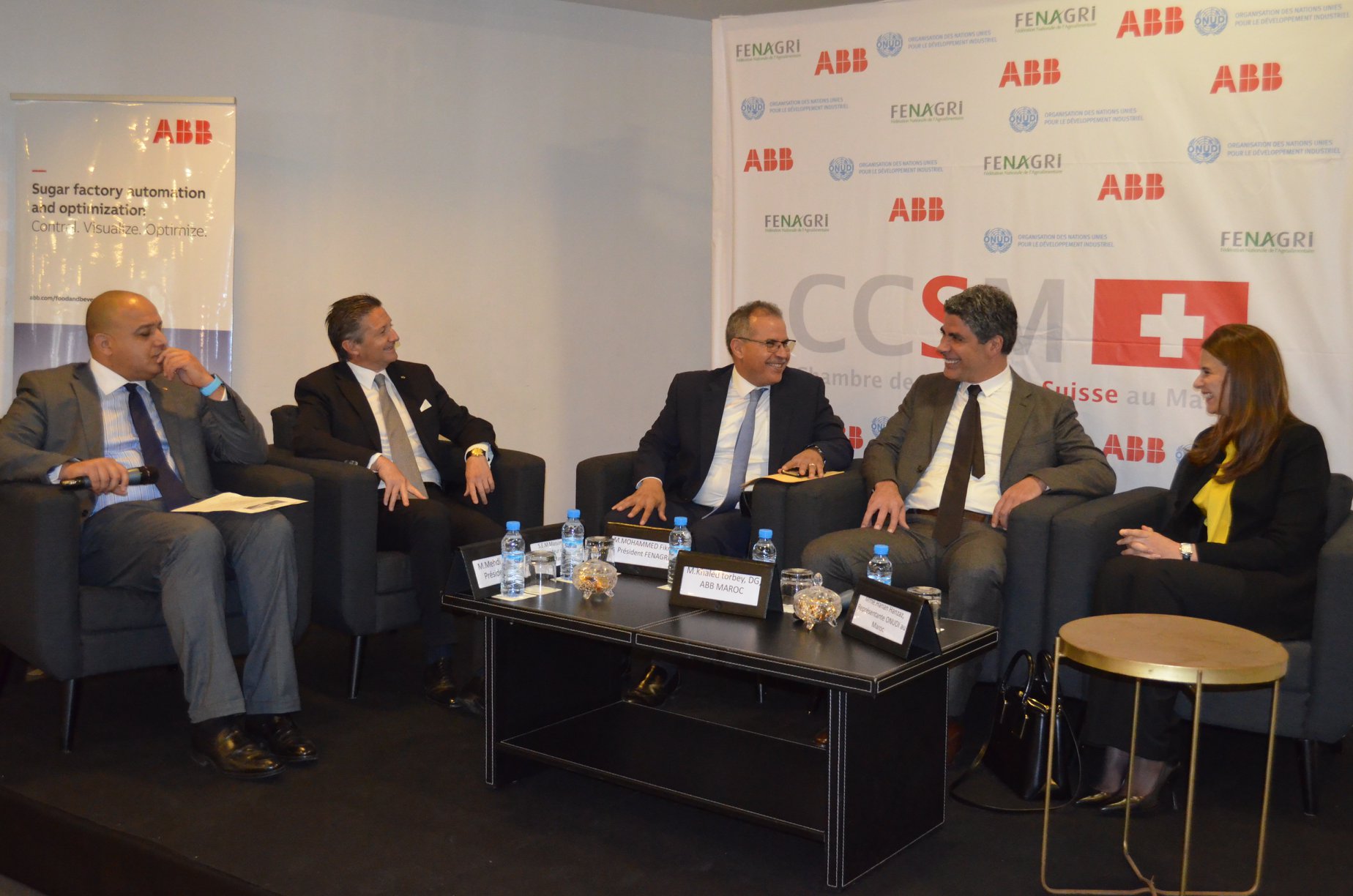
On 17 April in Casablanca, the event organised by the Swiss Chamber of Commerce in Morocco, in partnership with the National Agri-Food Federation, UNIDO and ABB, focused on the theme “Innovative technologies and digitalisation serving the agri-food industry”. At a time when new technologies are becoming indispensable tools for the industrial sector, this seminar addressed a crucial issue. Bringing together various professionals from the agri-food industry, digitalisation and robotics, the meeting aimed to exchange views and find solutions.
- Date
- Wednesday 16 May 2018
With the attendance of HE Mr Massimo Baggi, Ambassador of Switzerland to Morocco, Mr Mehdi Benzaari, President of the CCSM, Mr Khaled Torbey, Managing Director of ABB Maroc, Mr Mohammed Fikrat, President of FENAGRI, and Ms Hanan Hanzaz, UNIDO Representative in Morocco, the meeting provided an opportunity to take stock of the challenges of technology serving the agri-food industry, and also to discover the tailor-made solutions offered by ABB. From the outset of his speech, His Excellency the Ambassador of Switzerland to Morocco stressed that Morocco, through its achievements in agriculture, remains a reference in the field. The same is true of Switzerland, the largest coffee exporter in Europe even though there is not a single coffee plantation in its Alps. A satisfying reality, explained on the one hand by the global presence of Swiss multinationals such as Nestlé and Nespresso and, on the other, by its undisputed know-how in the field. He then turned to the theme of the meeting which, in his view, “addresses a real societal issue, because the agricultural sector is today closely linked to new technologies”, before continuing on a reassuring note: “Fortunately, Morocco has understood this in time and has begun to put good practices in place”.
Agri-food and new technologies, a necessary collaboration
The agri-food industry in Morocco has strong potential and offers many opportunities for foreign investment, as the speakers emphasised. The sector was indeed ranked the 2nd largest exporter in 2017, with a turnover of 52 billion dirhams. This performance has motivated players in the field such as FENAGRI to want to maintain, or even improve, their position. This ambition underpins the objective of the event organised jointly with the CCSM, UNIDO and ABB. According to Mr Mohamed Fikrat, “this meeting is a good starting point for reflection in order to adopt solutions suited to our needs and expectations”.
Indeed, as its President explained, “FENAGRI was admittedly created in 1996, but the agri-food industry in Morocco has always been a historic industry. With a turnover of 135 billion dirhams and added value of 30 billion dirhams, the agri-food industry accounts for 4% of Morocco’s GDP, while the agricultural sector contributes more than 13%”. According to the President, FENAGRI faces two main challenges. “The first is competitiveness and the second is energy efficiency, which guarantees sustainable productivity. This competitiveness can be fuelled by effective digitalisation and the adoption of processes that would improve quality and performance, as well as reassuring consumers through traceability”. ABB’s solutions therefore come at the right time. In this vein, Khaled Torbey, Managing Director of ABB Maroc, pointed out “that the digital revolution requires business models, strategies and processes to be reinvented in order to stay in the race”. Indeed, the upheavals brought about by computing and hyperconnectivity have not spared traditional sectors such as energy and industrial production. This revolution forces the various players, in this case those in agri-food and technology, to collaborate in order to accelerate innovation in a more open way and to engage in a dynamic of strategic and innovative partnerships that will shape the ecosystems of tomorrow. An approach that UNIDO encourages because it works for economic growth, certainly, but with respect for the environment. Indeed, “global industrial energy consumption increased by 41% between 1990 and 2012,” said Ms Hanan Hanzaz, UNIDO Representative in Morocco. A trend that the institution has striven to reverse. That is why “it has set up a sustainable development system and is pleased that Morocco is today among the top 5 countries in energy efficiency”. It is considering projects and putting in place programmes aimed at developing productive, high-performance agriculture while protecting the environment.
Digitalisation serving the agri-food industry
“By working with ABB, Morocco could make a major leap in quality,” said Khaled Torbey. Indeed, ABB’s leadership in cutting-edge technologies rests above all on solid, rational, forward-looking R&D. An idea reinforced by Mr Marcel Kail, representative of ABB France, who showed that “innovation is in ABB’s DNA. Many technologies that are indispensable today were invented by the Group over the last 130 years,” he maintained. In its seven research centres around the world, ABB continues to develop the advances that will revolutionise the daily lives of manufacturers and their customers. To do this, the Group “devotes around 1.5 billion dollars to it every year,” announced its Managing Director in Morocco. According to Marcel Kail, ABB offers solutions specialised in the needs of the agri-food industry, future-proof solutions compatible with the industry. “The solutions are focused on 5 segments with 4 core values: cost reduction and production efficiency, food and personal safety, product quality with good traceability and, finally, sustainable development for good energy optimisation,” he added. He also mentioned the two components of a digitalisation programme based on collaboration with B&R, a company well known for machinery, particularly for beverages, and on the implementation of the ABB Ability solution, which helps customers in industry, transport and infrastructure to develop new processes and refine existing ones by providing them with new data and optimising planning and controls for real-time operations. These results then feed into control systems to improve key indicators such as plant availability, speed and yield. On the basis of these results, Khaled Torbey encouraged the production sites present at the meeting to be active on all fronts: “Cost control, safety, product quality and meeting sustainability targets, but also higher production rates, shorter product cycles, adaptation to market fluctuations and differentiated production”. It was with this in mind that Mr Mohamed Farahneh, representative of ABB Dubai, also shed light on the subject: “In the next 5 years, 2/3 of the world’s factories will be digitalised. However, a good number of manufacturers think they are not yet ready for Industry 4.0. For this reason, collaboration is necessary to progress and stay in the race”. He went on to add: “Morocco has great potential and an ambitious strategy that we must and can accelerate together.” And Khaled Torbey added that “Morocco could well contribute through its experience, thus playing a greater role as a hub and development model for the countries of the African continent”. According to him, “FENAGRI and many other companies are well-positioned partners to export their experience and know-how”. To this range of solutions, the leader in pioneering technologies also added robotics.
Robotics for greater productivity and competitiveness
According to Mohamed Achouri, another ABB representative, who spoke during the panel on “Robotics serving the agri-food industry”, ABB offers high-performance, reliable robots. Its machines, which can be programmed and controlled at any time, make it possible to follow and respond to trends in the sector. According to him, the robots offered by the technology leader can work individually but also in collaboration with humans. They are high-performance, flexible production equipment, ensure reliability, productivity, hygiene and safety, and are capable of carrying out picking as well as packing, palletising or processing. During his video demonstration, Mohamed Achouri explained that “picking refers to picking up and placing on the fly at a very high rate. Packing, for its part, concerns flexible, reliable and highly compact case packing, while palletising concerns the handling of cartons, bags, bottles, trays or packaged products. Finally, there is processing, where the robots meet food industry standards and can be integrated at the heart of processes. These robots provide flexibility and sophisticated software functions”. In conclusion, the SGS representative, Ms Kaoutare Tachfine, welcomed the various solutions presented throughout the seminar. She took the opportunity to briefly present SGS’s solutions through its “Agriculture and Food” department. A unit offering a range of end-to-end supply chain services that reduce risks, guarantee quality and improve productivity.
As a reminder, ABB, with a 125-year heritage of technological innovation, is a leader in pioneering technologies in electrification products, robotics, industrial automation and power grids, serving customers in utilities, industry, transport and infrastructure around the world.
TESTIMONIALS
This day was prepared and designed jointly with Mr Torbey, Managing Director of ABB Maroc, the CCSM and UNIDO. It is driven by two factors. The first is that the agri-food industry is a very important sector on the Moroccan economic scene and has a great deal of potential. Quite a few companies have been operating for several decades in diverse sectors and now need greater competitiveness and energy efficiency. Listening to the presentations by ABB and UNIDO, we are reassured to see that they are devising programmes to promote the digitalisation of companies through new technologies. ABB’s programme is very interesting since it has solutions that are not limited to supplying equipment but support companies that so wish in identifying sources of improvement in their performance through digitalisation. As we know, developed countries embarked on Industry 4.0 a long time ago and are showing satisfactory results. It is not too late to board this high-speed train. Mr Mohammed Fikrat , President of FENAGRI
You will remember how, in 2007, the iPhone established itself over BlackBerry phones after its launch. Ten years later, we can glimpse the upheavals brought about by computing and hyperconnectivity: new technologies and disruptive innovations have multiplied to the point of setting the pace of our lives, at home and at work. Traditional sectors such as energy and industrial production are no longer spared by the digital revolution. This revolution is forcing the players present today to collaborate in order to accelerate innovation and to engage in a dynamic of strategic and innovative partnerships that will shape the ecosystems of tomorrow. We thank all the partners with whom we jointly organised this event. Mr Khaled Torbey , Managing Director, ABB Maroc
As partners of the event organised by ABB, we are here today to present UNIDO’s activities in the sector, and in particular the industrial energy efficiency accelerator. Agri-food is very important for UNIDO. Most of our technical assistance activities for developing countries concern this sector. Our approach is based on the exchange of values and our goal is to contribute to inclusive and sustainable industrial development at country level. The agri-food sector enables us to achieve very concrete results. Half of developing countries’ exports are in agri-food. That is why we seek to help companies become more competitive. As a specialised agency of the United Nations, we have set ourselves the goal of supporting member countries in successfully making the transition to this digital revolution. The solutions presented by ABB are based on proven expertise that will enable companies in Morocco and elsewhere to be more productive and competitive. Ms Hanan Hanzaz , UNIDO Representative in Morocco
Robotic solutions applied in the agri-food segment are eagerly awaited. They are coming at the right time, especially since, according to the UNICEF study, the population will increase by 3.1 billion people from 2010 to 2050. These statistics imply that we need to produce more in 40 years than we have produced in 8,000 years. It is an enormous challenge that requires not just human strength but robotic strength. Mr Mohamed Achouri , ABB, Agri-Food and Automotive Sector Manager
This is an enriching event between experts and professionals in agri-food, digitalisation and robotics – in short, new technologies. UNIDO has chosen Morocco as one of the first 6 countries in which it plans to put in place solutions to accelerate energy efficiency. This will benefit the country, especially as a study carried out in 2014 shows that the agri-food industry ranks second in terms of energy consumption after cement manufacturers and materials operators. Improving energy efficiency is therefore a major challenge in Morocco, and our ambition is to come up with proposed solutions. I thank FENAGRI for their trust and their involvement in the organisation, ABB for its excellent solutions and UNIDO for its commitment to this event. Mr Mehdi Benzaari , President, Swiss Chamber of Commerce in Morocco
Take your business international
Join a network of leading, forward-thinking executives and business leaders to accelerate your bilateral business opportunities.
Become a member