














2018 Finance Act: what will change!
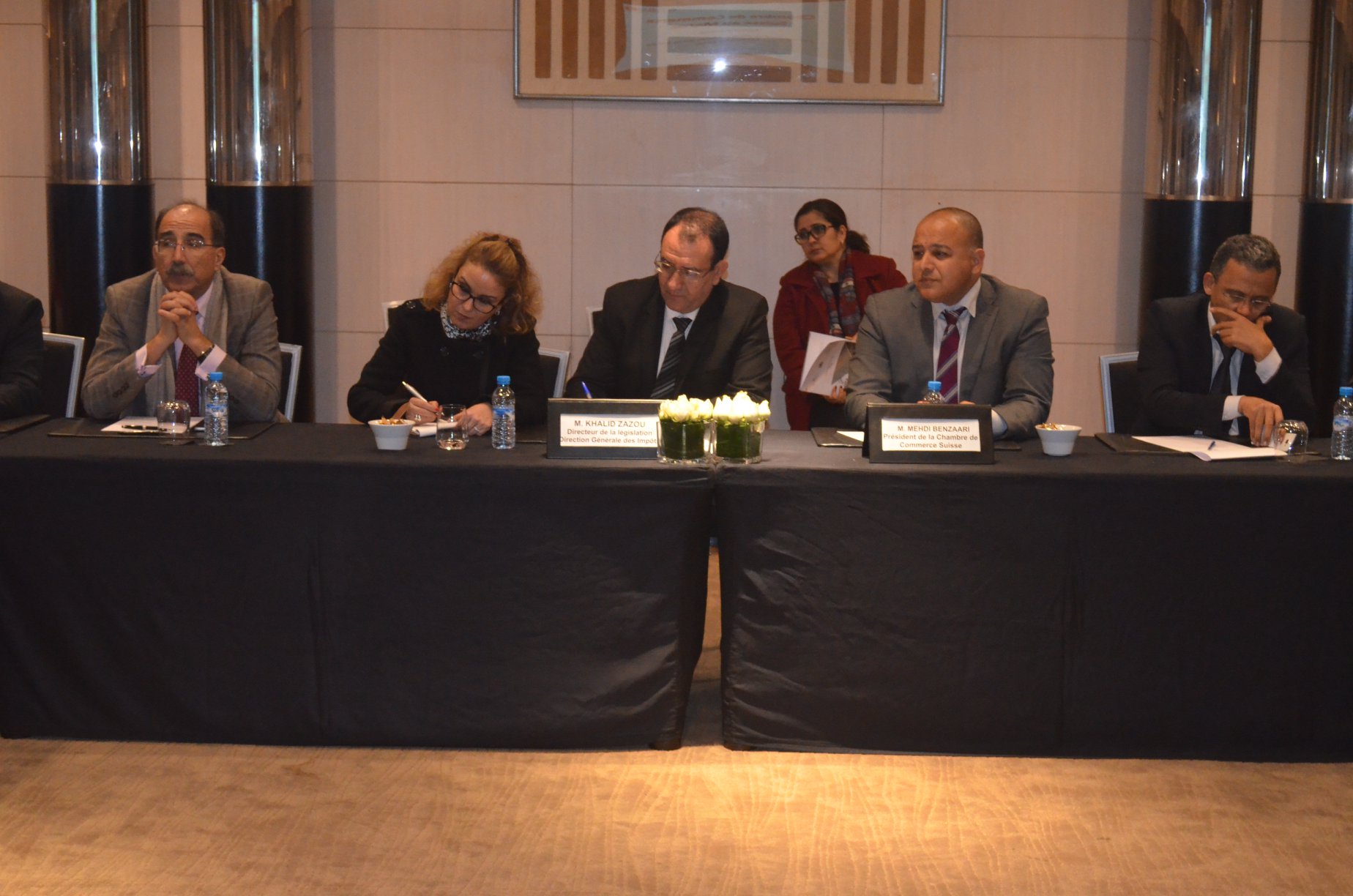
It was Mr Khalid Zazou, Director of Legislation and International Cooperation at the General Tax Directorate, who presented the new provisions of the 2018 Finance Act at the round table organised by the Swiss Chamber of Commerce in Morocco. Held on 21 February in Casablanca before a large audience of economic and financial operators from both the private and public sectors, the meeting shed light on certain tax ambiguities and presented the new series of measures defined by the Ministry of Economy and Finance.
- Date
- Wednesday 16 May 2018
This special exchange was kicked off by Mr Zazou, Director of Legislation and International Cooperation at the General Tax Directorate (DGI). In the presence of Mr Mehdi Benzaari, President of the CCSM, and a gathering of economic players and financial experts, he presented the main features of the new reform of the 2018 Finance Act. All the tax provisions were set out and explained to participants. Important parameters, namely the measures specific to corporate income tax, personal income tax, value added tax, registration duties and stamp duties, as well as those common to IS (corporate income tax) and IR (personal income tax), were reviewed as part of this reform.
Encouraging investment and exports
Prospects for developing private investment were examined. A series of measures helping to promote business creation has indeed been included in the new texts. They notably involve the abolition of registration duty on the formation of share capital and the entry into force of progressive corporate income tax (IS) for SMEs. Companies are thus invited to adopt a new method of calculating IS: 10% for the turnover bracket below 300,000 dirhams, 20% for the bracket between 300,001 and 1 million dirhams, and 31% for those exceeding one million dirhams. A new situation that benefits SMEs and will reduce the tax burden on economic operators.
Facilitating the recovery of arrears
Another new feature of this reform is the waiver of fines, surcharges and other penalties relating to arrears unpaid before 2016, if and only if payment is made before 1 January 2019. Through this measure, effective since 1 January 2018, the State is granting late payers a one-year period to encourage them to pay their arrears without being discouraged by penalties or other sanctions.
Ensuring taxpayer protection
“Taxpayers subject to income tax on real estate gains may continue to file in writing, on or according to the form drawn up by the administration, the return referred to in Article 83 of the CGI and to pay the tax voluntarily to the tax administration’s collector, until 30 June 2018.” With these words, Mr Zazou recalled that individual taxpayers can now benefit from a certain grace period from 1 January until the end of June 2018 to carry out electronically the filing and payment of tax for certain tax returns, such as the annual return of overall income for persons receiving property income, salary income, income from fixed-income investments, and foreign-source income and gains provided for in Article 82 of the General Tax Code, and the declaration of payment of foreign-source income and gains from movable capital provided for in Article 173-1 of the Code…
Diversified measures…
Stamp duty will no longer be required for certain documents such as reports relating to road accidents, passes for pilgrims or vaccination certificates. “However, the stamp duty on passports – which, it should be noted, will now become electronic – will rise from 300 to 500 dirhams,” said Mr Zazou. As regards stamp duties on vehicles, non-polluting vehicles will be exempt. An initiative that encourages contributing to environmental protection. Medicines prescribed for the treatment of meningitis will be exempt from import VAT, as will medicines for cancer or AIDS. A social measure long called for by patients and health professionals, which has just been granted.
…tailored to different sectors of activity
To conclude, Mr Zazou also mentioned the measures taken according to sector of activity. “Covering around 55 points, the new provisions of the 2018 Finance Act, which are essentially tax-related, have affected agriculture, tourism, fishing, sport, the agri-food industry, the automotive industry, real estate, health, insurance…,” said Mr Zazou. For each sector of activity, questions relating to VAT, IR, IS, exemptions, facilitation measures, fines and sanctions were raised.
As well as being an opportunity for exchange between CCSM members and the DGI, this round table also provided a framework for bringing the companies present closer to the tax administration.
TESTIMONIALS
I am delighted to take part in this round table, which was as rich in the importance of its subject as in the fascinating debate that followed. The new provisions of the Finance Act delight most economic players because they encourage the development of industrialisation and investment, and support for small and medium-sized enterprises (SMEs). The participants were already aware of them, but this meeting made it possible to provide some answers on very specific points. Thank you to the CCSM for this excellent initiative. Khalid Zazou , Director at the DGI
This round table comes at just the right time. We were able to discuss the new measures and share the experiences and opinions of the various experts who took part in the meeting. The measures are certainly numerous, but participants took the opportunity to debate mainly those relating to companies, IR and IS, investment, exports… Thanks to the expertise of Mr Zazou and his team, we received answers to all our questions about the new provisions of the 2018 Finance Act. Mr Mehdi Benzaari , President of the CCSM
Take your business international
Join a network of leading, forward-thinking executives and business leaders to accelerate your bilateral business opportunities.
Become a member